
Deep fields & lensing
Galaxies Used to Refine the Hubble Constant
July 16, 2019 · NASA · M101, NGC 1448, NGC 1365
These galaxies are selected from a Hubble Space Telescope program to measure the expansion rate of the universe, called the Hubble constant. The value is calculated by comparing the galaxies' distances to the apparent rate of recession away from Earth (due to the relativistic effects of expanding space).
By comparing the apparent brightnesses of the galaxies' red giant stars with nearby red giants, whose distances were measured with other methods, astronomers are able to determine how far away each of the host galaxies are. This is possible because red giants are reliable milepost markers because they all reach the same peak brightness in their late evolution. And, this can be used as a "standard candle" to calculate distance. Hubble's exquisite sharpness and sensitivity allowed for red giants to be found in the stellar halos of the host galaxies.
The red giants were searched for in the halos of the galaxies. The center row shows Hubble's full field of view. The bottom row zooms even tighter into the Hubble fields. The red giants are identified by yellow circles.
About the colours
These images are a composite of separate exposures acquired by the WFC3/UVIS instrument on the Hubble Space Telescope. Several filters were used to sample narrow wavelength ranges. The color results from assigning different hues (colors) to each monochromatic (grayscale) image associated with an individual filter. In this case, the assigned colors are: Cyan: F606W Orange: F814W
About the data
The HST observations include those from program 13691 (W. Freedman)
More deep fields & lensing
 Map of the Cosmic Web Generated from Slime Mould AlgorithmMarch 10, 2020
 Hubblecast 125 Light: Hubble Studies High-Energy Gamma Ray BurstNovember 20, 2019 · video
 Pan of the Sunburst ArcNovember 7, 2019 · video
 Dark Matter in the Belly of the WhaleSeptember 9, 2019
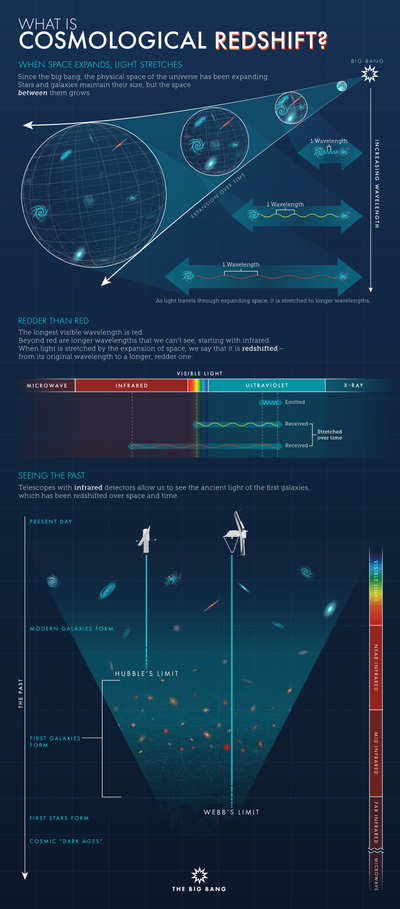 What is Cosmological Redshift?June 6, 2019
 The Hubble Deep FieldMay 2, 2019
 Zooming in on the Hubble Legacy FieldMay 2, 2019 · video
 Pan across the Hubble Legacy FieldMay 2, 2019 · video