
Black holes
Black-Hole-Driven Outflow From Active Galaxy NGC 1068
December 9, 2021 · NASA · Cetus
Zoom to full resolution See where it is in the 3D sky Original on NASA ↗
The nearby barred-spiral galaxy NGC 1068 serves as a proxy for helping astronomers understand the fireworks taking place at the center of our Milky Way galaxy, driven by eruptions from a supermassive black hole. Because we live inside the Milky Way, much of our view of the galaxy’s center is blocked by intervening clouds of gas and dust. But, looking 45 million light-years away at NGC 1068 gives astronomers a birds-eye view of similar black hole outbursts. The inset Hubble Space Telescope image resolves hydrogen clouds as small as 10 light-years across within 150 light-years of the core. The clouds are glowing because they are caught in a "searchlight" of radiation beamed out of the galaxy's black hole, which is larger and more active than the black hole in the heart of our galaxy.
About the colours
This image is a composite of separate exposures acquired by the instruments on the Hubble Space Telescope. Several filters were used to sample wide and narrow wavelength ranges. The color results from assigning different hues (colors) to each monochromatic (grayscale) image associated with an individual filter. In this case, the assigned colors are: Cyan: F606W, Orange: F814W, Red: F658N
About the data
The HST observations include those from programs 5479 (M.Malkan), 16179 (A. Filippenko), 9788 (C. Hu), and 5578 (W. Sparks)
More Hubble images of NGC 1068
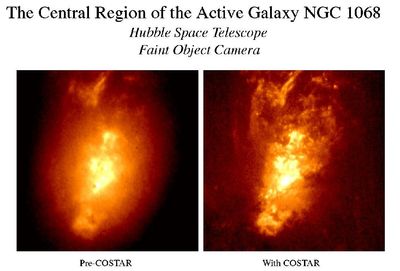 HST Reveals the Central Region of an Active GalaxyJanuary 13, 1994
Early Hubble Image of Galaxy NGC 1068January 13, 1994
Image of Galaxy NGC 1068, Taken After Hubble’s First Servicing MissionJanuary 13, 1994
NGC 1068 Nucleus and Ionizing ConeOctober 4, 1990
NGC 1068 and Nuclear Region – Wide Field/Planetary CameraOctober 4, 1990
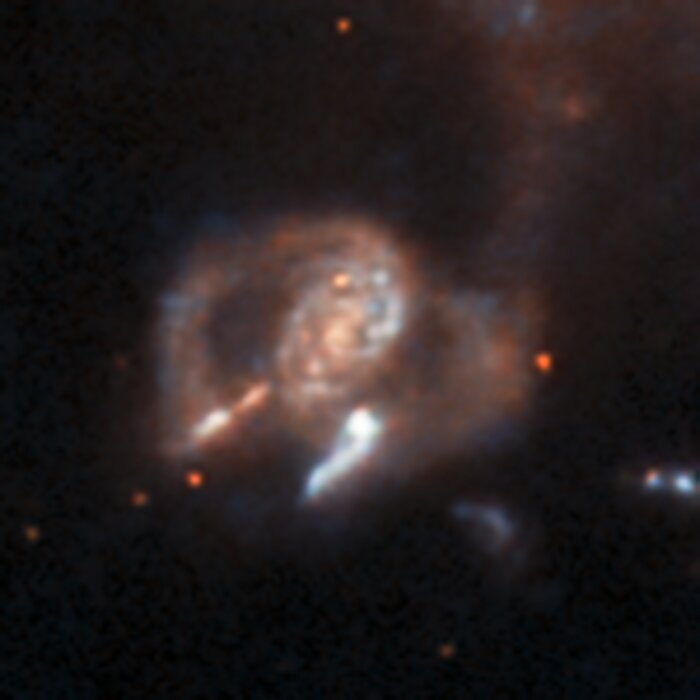 An anomaly from Hubble’s archive — Unknown objectJanuary 27, 2026
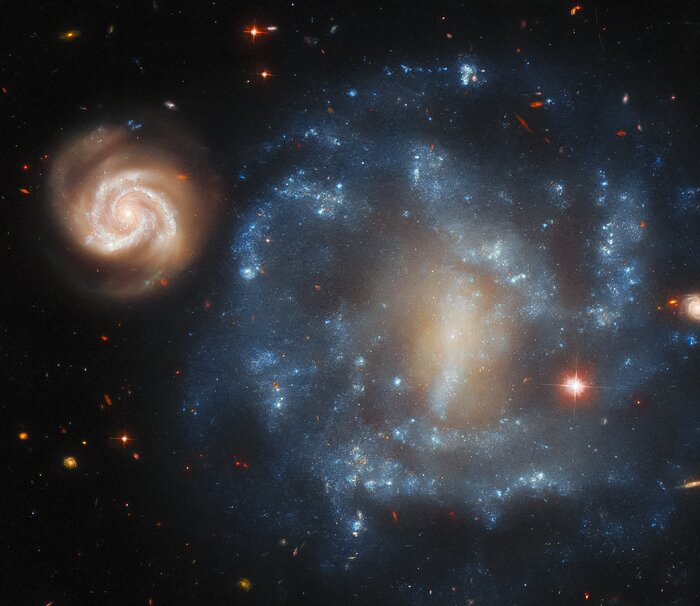 Long-distance relationshipDecember 22, 2025
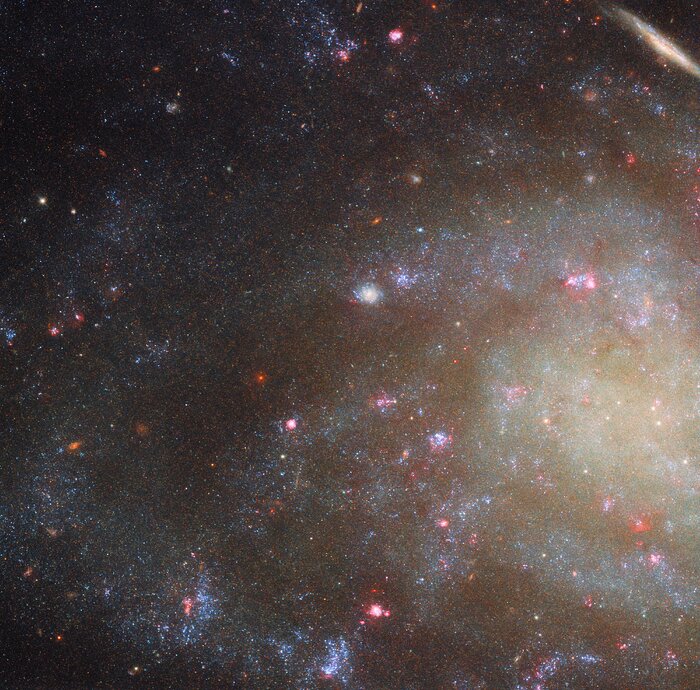 Low brightness, high interestAugust 11, 2025