
Solar System
Comet C/2014 UN271 Nucleus
April 12, 2022 · NASA
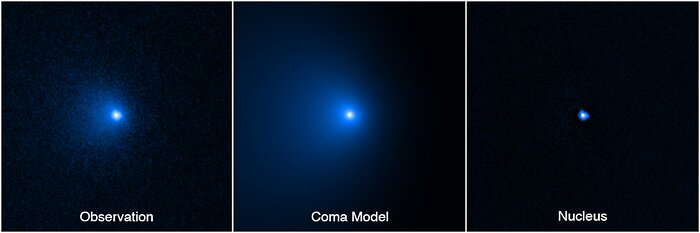
This sequence shows how the nucleus of Comet C/2014 UN271 (Bernardinelli-Bernstein) was isolated from a vast shell of dust and gas surrounding the solid icy nucleus. On the left is a photo of the comet taken by the NASA Hubble Space Telescope's Wide Field Camera 3 on January 8, 2022. A model of the coma (middle panel) was obtained by means of fitting the surface brightness profile assembled from the observed image on the left. This allowed for the coma to be subtracted, unveiling the point-like glow from the nucleus. Combined with radio telescope data, astronomers arrived at a precise measurement of the nucleus size. That's no small feat from something about 2 billion miles away. Though the nucleus is estimated to be as large as 85 miles across, it is so far away it cannot be resolved by Hubble. Its size is derived from its reflectivity as measured by Hubble. The nucleus is estimated to be as black as charcoal. The nucleus area is gleaned from radio observations.
About the colours
This image is an exposure acquired by the WFC3 instrument on the Hubble Space Telescope. The color results from assigning the color blue to a monochromatic (grayscale) image.
About the data
HST observations include those from programs 16886 (M. Hui).
More solar system
 Asteroid Trails MosaicMay 6, 2022
 Abell 370 Parallel Field with AsteroidsMay 6, 2022
 Broken Asteroid Trail in NGC 4548May 6, 2022
 Hubble Confirms Largest Comet Nucleus Ever SeenApril 12, 2022
AB Aurigae b Hubble ImagesApril 4, 2022
 Hubble's full photomap of PlutoMarch 7, 2022
A Sample of Images from Hubble’s Advanced Camera for SurveysMarch 7, 2022