
Star clusters
Omega Centauri
July 10, 2024 · NASA · Omega Centauri, NGC 5139 · Centaurus
Zoom to full resolution See where it is in the 3D sky Original on NASA ↗
An international team of astronomers has used more than 500 images from NASA's Hubble Space Telescope – spanning two decades of observations – to detect seven fast-moving stars in the innermost region of the globular star cluster Omega Centauri, the largest and brightest globular cluster in the sky. These stars provide new compelling evidence for the presence of the gravitational pull from an intermediate-mass black hole (IMBH) tugging on them. Only a few other IMBH candidates have been found to date.
Omega Centauri is visible from Earth with the naked eye and is one of the favorite celestial objects for stargazers living in the southern hemisphere. Although the cluster is 17,700 light-years away, located just above the plane of the Milky Way, it appears almost as large as the full Moon when seen from a dark rural area. The exact classification of Omega Centauri has evolved through time, as our ability to study it has improved. It was first listed in Ptolemy's catalog nearly 2,000 years ago as a single star. Edmond Halley reported it as a nebula in 1677. In the 1830s the English astronomer John Herschel was the first to recognize it as a globular cluster. Omega Centauri consists of roughly 10 million stars that are gravitationally bound. The cluster is about 10 times as massive as other big globular clusters – almost as massive as a small galaxy.
About the colours
These images are a composite of separate exposures acquired by the WFC3/UVIS instrument on the Hubble Space Telescope. Several filters were used to sample various wavelength ranges. The color results from assigning different hues (colors) to each monochromatic (grayscale) image associated with an individual filter. In this case, the assigned colors are: Blue= F275W + F336W + F438W, Green= F606W + F625W, Red= F658N + F814W
About the data
The HST observations include those from programs 9442 (A. Cool), 10252 (J. Anderson), 10775 , (A. Sarajedini), 12193 (J. Lee), 13066 (L. Smith), 13606 (J. Anderson), 15594 (V. Kozhurina-Platais), 15764 (N. Hathi), 15857 (A. Bellini), 16380 (M. Chiaberge), 16384 (Y. Cohen), 16520 (N. Hathi), 16968 (N. Hathi), 11452 (J. Quijano), 11011 (C. Kochnek), 12094 (L. Petro), 12339 (E. Sabbi), 12353 (V. Kozhurina-Platais), 12580 (A. Renzini), 12694 (K. Long), 12700 (A. Riess), 12714 (V. Kozhurina-Platais), 12802 (J. MacKenty), 13100 (V. Kozhurina-Platais), 13570 (V. Kozhurina-Platais), 14031 (V. Kozhurina-Platais), 14393 (V. Kozhurina-Platais), 14550 (V. Kozhurina-Platais), 14759 (T. Brown), 15000 (V. Kozhurina-Platais), 15593 (V. Kozhurina-Platais), 15594 (V. Kozhurina-Platais), 15733 (V. Kozhurina-Platais), 15857 (A. Bellini), 16117 (M. Reinhart), 16514 (R. Bohlin), 16441 (J. Anderson), 16588 (V. Kozhurina-Platais), 16777 (A. Seth), and 17023 (C. Martlin).
This dataset contains HST observations of the globular cluster Omega Centauri out to its half-light radius. The data were selected to contain all available observations with filters suitable for high-precision astrometry (ACS/WFC: F435W, F475W, F555W, F606W, F625W, F775W, F814W; WFC3/UVIS: F336W, F390W, F438W, F555W, F606W, F775W, F814W). In addition, the filters ACS/WFC F658N and WFC3/UVIS F275W were added for photometric purposes as they also cover almost the entire half-light radius. The data were taken in the time spanning from June 2002 to March 2023. They have been collectively compiled here .
More Hubble images of Omega Centauri, NGC 5139
IMBH Candidate in Omega CentauriJuly 10, 2024
Omega Centauri (cropped)July 10, 2024
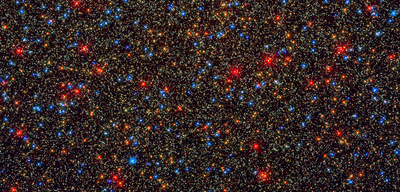 Core of Omega CentauriOctober 26, 2010
Omega CentauriSeptember 9, 2009
Colorful Stars Galore Inside Globular Star Cluster Omega CentauriSeptember 9, 2009
Starry Splendor in Core of Omega CentauriApril 2, 2008
Peering into the Core of Globular Cluster Omega CentauriOctober 4, 2001
 Channelling light from starburstsJune 24, 2024