
Solar System
Mars Corona
September 5, 2024 · NASA
These are far-ultraviolet Hubble images of Mars near its farthest point from the Sun, called aphelion, on December 31, 2017 (top), and near its closest approach to the Sun, called perihelion, on December 19, 2016 (bottom). The atmosphere is clearly brighter and more extended when Mars is close to the Sun.
Reflected sunlight from Mars at these wavelengths shows scattering by atmospheric molecules and haze, while the polar ice caps and some surface features are also visible. Hubble and MAVEN showed that Martian atmospheric conditions change very quickly. When Mars is close to the Sun, water molecules rise very rapidly through the atmosphere, breaking apart and releasing atoms at high altitudes.
About the colours
This image is acquired by the ACS instrument on the Hubble Space Telescope. The color results from assigning a red hue to a monochromatic (grayscale) image.
About the data
The HST observations include those from programs 14752 (J. Clarke) and 15097 (D. Bhattacharyya)
More Hubble images of Mars
Mars Near Opposition 2024April 23, 2025
Mars Oppositions 2016 and 2018July 26, 2018
Mars Near 2016 OppositionMay 19, 2016
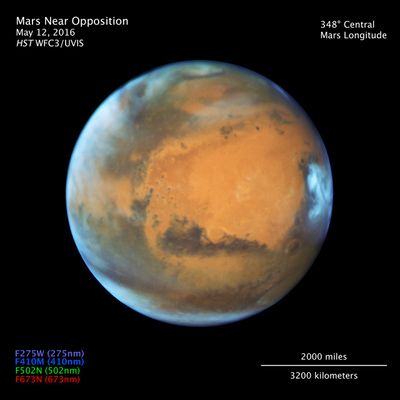 Scale Image for MarsMay 19, 2016
Mars – October 18, 2014October 23, 2014
Mars: Closest Approach 2007December 18, 2007
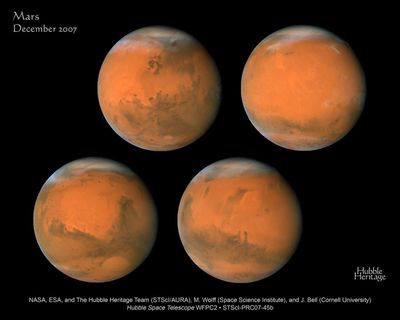 Mars: December 2007December 18, 2007
Image: Mars on Dec. 1, 2007; longitude ~50 degreesDecember 18, 2007