
Stars
Milky Way Bulge
January 11, 2018 · NASA · Sagittarius
Zoom to full resolution See where it is in the 3D sky Original on NASA ↗
Hubble Captures Glittering Crowded Hub of our Milky Way Galaxy
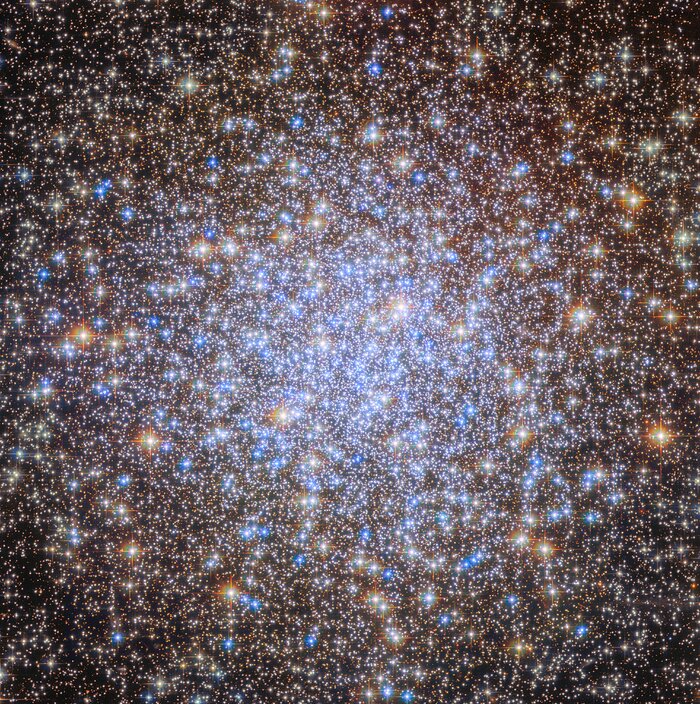
This Hubble Space Telescope image of a sparkling jewel box full of stars captures the heart of our Milky Way galaxy.
Aging red giant stars coexist with their more plentiful younger cousins, the smaller, white, Sun-like stars, in this crowded region of our galaxy’s ancient central hub, or bulge. Most of the bright blue stars in the image are probably recently formed stars located in the foreground, in the galaxy's disk. Astronomers studied 10,000 of these Sun-like stars in archival Hubble images over a nine-year period to unearth clues to our galaxy’s evolution.
The study reveals that the Milky Way’s bulge is a dynamic environment of variously aged stars zipping around at different speeds, like travelers bustling about a busy airport.
The researchers found that the motions of bulge stars are different, depending on a star’s chemical composition. Stars richer in elements heavier than hydrogen and helium have less disordered motions, but are orbiting around the galactic center faster than older stars that are deficient in heavier elements.
The image is a composite of exposures taken in near-infrared and visible light with Hubble’s Wide Field Camera 3. The observations are part of two Hubble surveys: the Galactic Bulge Treasury Program and the Sagittarius Window Eclipsing Extrasolar Planet Search.
The center of our galaxy is about 26,000 light-years away.
About the colours
These images are a composite of separate exposures acquired by the WFC3/IR and WFC3/UVIS instruments on the Hubble Space Telescope. Several filters were used to sample various wavelength ranges. The color results from assigning different hues (colors) to each monochromatic (grayscale) image associated with an individual filter. In this case, the assigned colors are: Blue: F555W Green: F814W Red: F110W +F160W
About the data
The HST observations include those from programs 11664 (T. Brown) and 12586 (K. Sahu)
More from Sagittarius and nearby
 Starry chandelierJune 26, 2026
 Bulge Fossil Fragment Terzan 5 (Webb and Hubble Image)June 16, 2026
 Hubble/Roman Galactic Bulge Survey Region (VISTA VVV Survey)May 11, 2026
 Microlensing Event at OGLE-2013-BLG-0341 (Hubble Image)May 11, 2026
 Trifid Nebula (Wide Field Camera 3 Image)April 20, 2026
Terzan 12September 7, 2023
 NGC 6652July 31, 2023
 On the edge of the LagoonJune 19, 2023