Deep fields & lensing
Hubble pushed beyond limits to spot clumps of new stars in distant galaxy
July 10, 2017 · ESA/Hubble · SDSS J1110+6459, SGAS J111020.0+645950.8
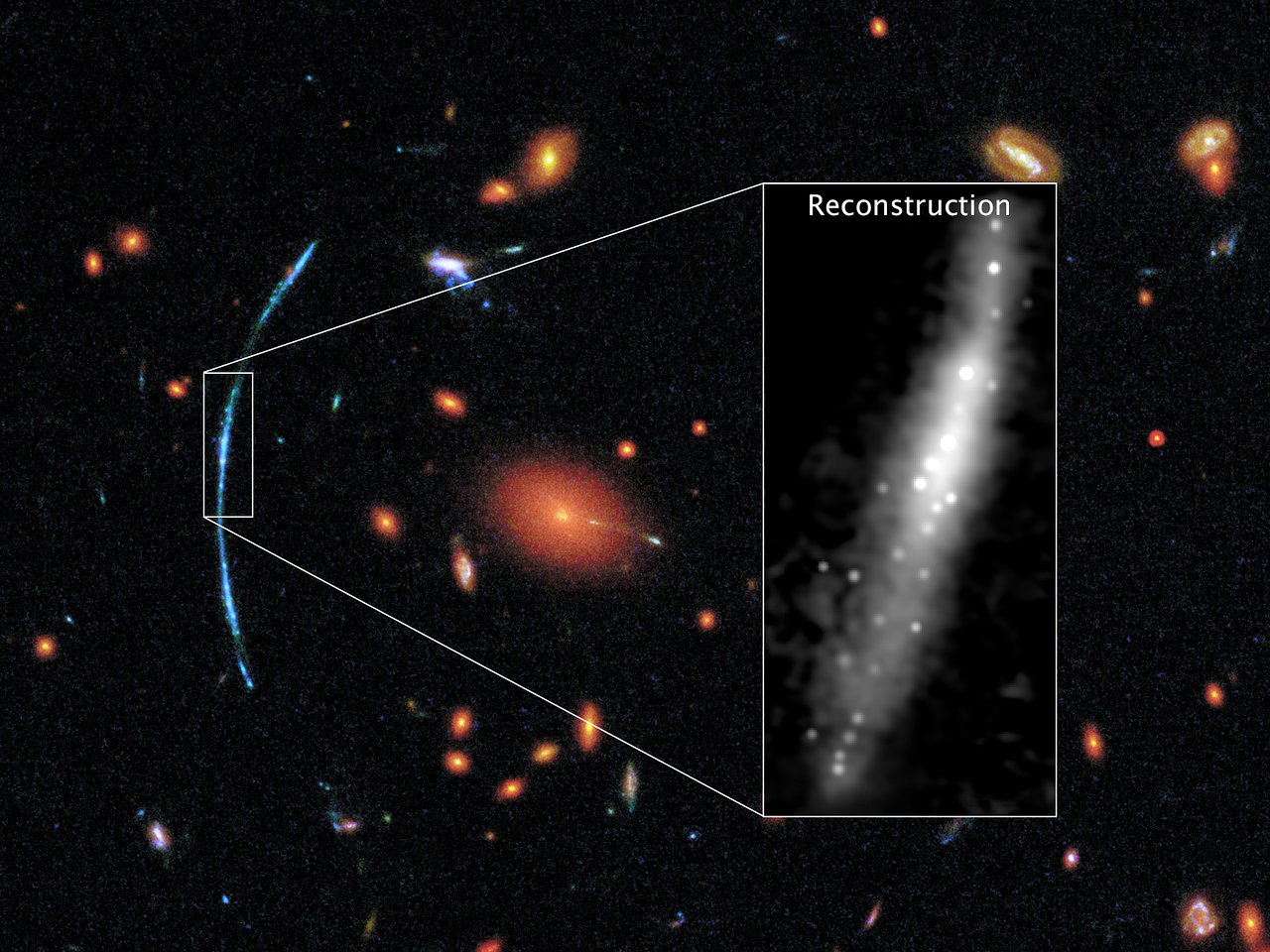
In this Hubble image of a distant galaxy cluster , a spotty blue arc stands out dramatically against a background of red galaxies. That arc is actually three separate images of the same background galaxy. The background galaxy has been gravitationally lensed , its light magnified and distorted by the intervening galaxy cluster.
By using the magnifying power of this natural cosmic lens, astronomers have been able to study the background galaxy in intimate detail. Through sophisticated computer processing, they determined how the galaxy’s image has been warped by gravity. The image at right shows how the galaxy would look to Hubble without distortions.
It reveals a disc galaxy containing clumps of star formation that each span about 200 to 300 light-years. This contradicts theories suggesting that star-forming regions in the distant, early Universe were much larger, 3000 light-years or more in size.
More deep fields & lensing
 Galaxy cluster MACSJ1206November 20, 2017
 Abell’s richest clusterOctober 30, 2017
 Cosmic archaeologyOctober 23, 2017
A Flight Through the CANDELS Ultra Deep Survey FieldSeptember 29, 2017 · video
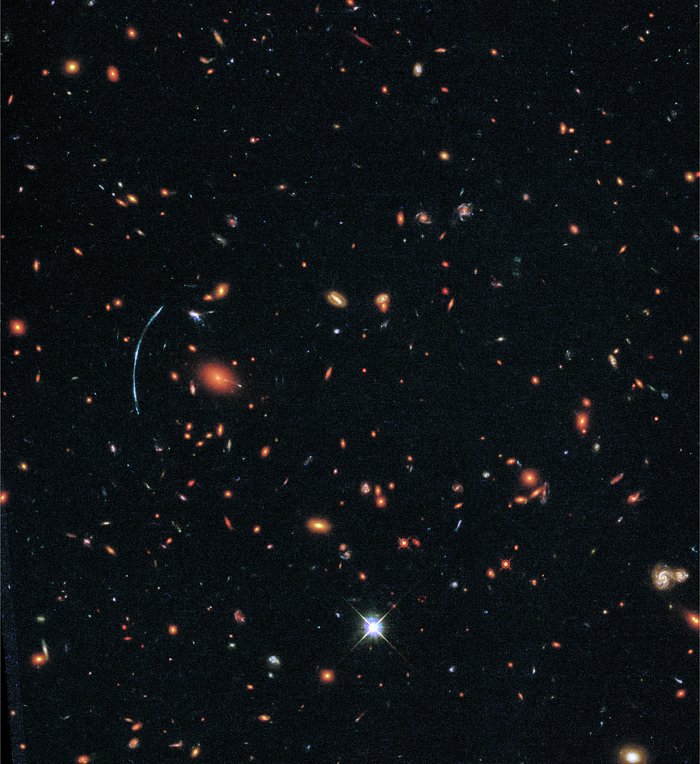 Wide field image of galaxy cluster SDSS J1110+6459July 10, 2017
Hubble Pushed Beyond Limits to Spot Clumps of New Stars in Distant GalaxyJuly 6, 2017
Wide Field Image of Galaxy Cluster SDSS J1110+6459July 6, 2017
 Galaxy cluster MACS J2129-0741June 22, 2017