Illustrations
Hubble Maps a Giant Halo Around the Andromeda Galaxy
August 28, 2020 · ESA/Hubble
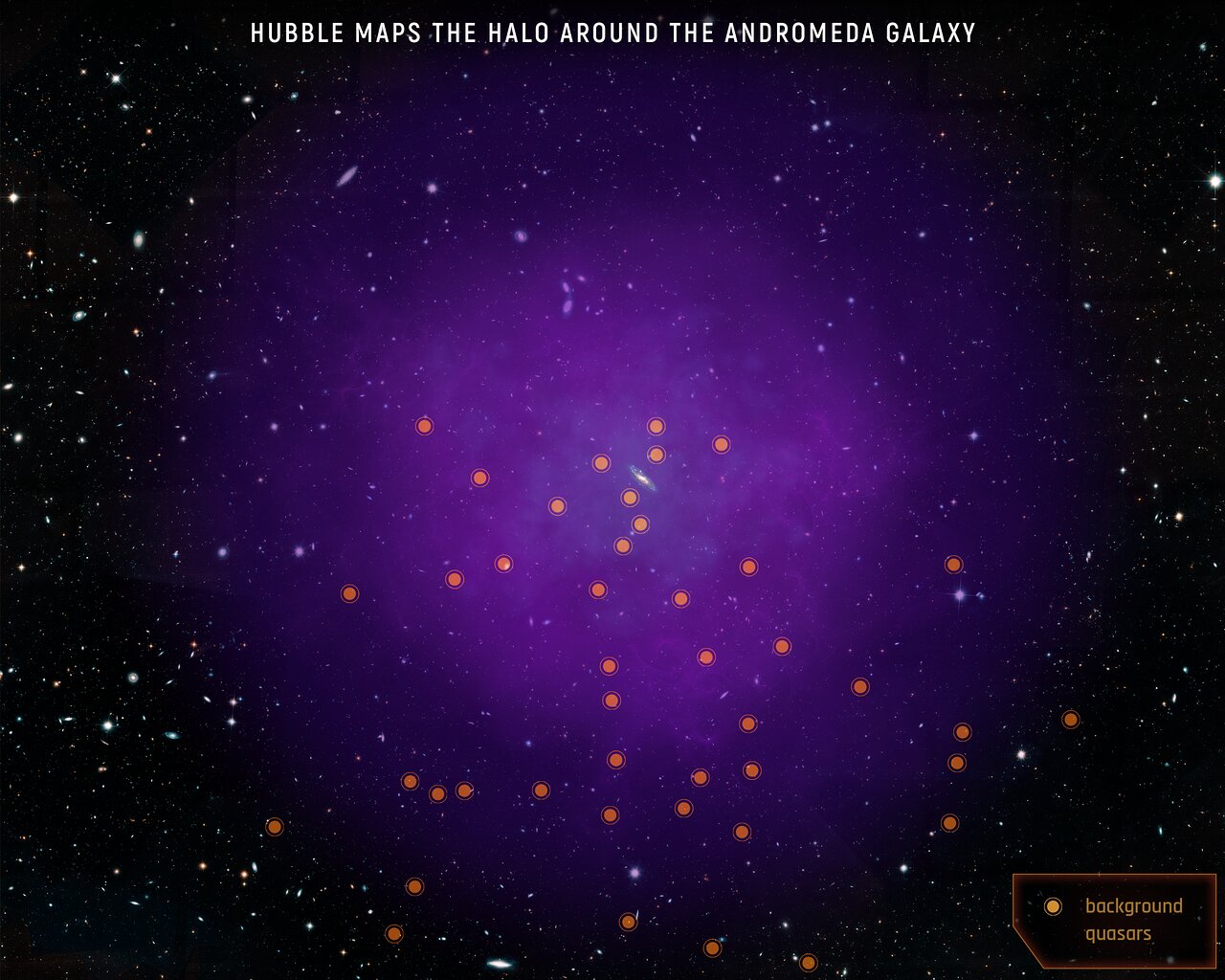
Scientists using the NASA/ESA Hubble Space Telescope have mapped the immense halo of gas enveloping the Andromeda galaxy, our nearest large galactic neighbor. Scientists were surprised to find that this nearly invisible halo of diffuse plasma extends 1.3 million light-years from the galaxy—about halfway to our Milky Way—and as far as 2 million light-years in some directions. They also found that the halo has a layered structure, with two main nested and distinct shells of gas.
This is the most comprehensive study of a halo surrounding a galaxy. Called Project AMIGA (Absorption Map of Ionized Gas in Andromeda), the study examined the light from 43 quasars—the very distant, brilliant cores of active galaxies powered by black holes—located far beyond Andromeda. The quasars are scattered behind the halo, allowing scientists to probe multiple regions. Looking through the halo at the quasars’ light, the team observed how this light is absorbed by the Andromeda halo and how that absorption changes in different regions.
More Hubble images of Andromeda Galaxy
 Andromeda GalaxyJuly 27, 2026
Artist’s Illustration of Exoplanet HD 106906 b’s OrbitDecember 10, 2020
Collision Sequence for a Magnetar-Powered Kilonova Blast IllustrationNovember 12, 2020
 Hubble Sheds Light on Small-Scale Concentrations of Dark Matter (Artist’s Impression)September 10, 2020
 Small-Scale Concentrations of Dark Matter (Artist’s Impression)September 10, 2020
Halo Around the Andromeda Galaxy IllustrationAugust 27, 2020
M31 Halo Illustration over Rocky TerrainAugust 27, 2020
 Collage of Hubble 30 Artistic CreationsAugust 26, 2020