
Galaxies
Andromeda Galaxy
July 27, 2026 · NASA · Andromeda
Zoom to full resolution See where it is in the 3D sky Original on NASA ↗
Astronomers have divided imagery of the Andromeda galaxy taken by NASA’s Hubble Space Telescope into thousands of squares 300 light-years on a side and determined the history of star formation within each parcel to gain a comprehensive view of the galaxy’s past. This image highlights two such regions. Massive stars are bluer and short-lived, while less massive stars are redder and longer-lived. As a result, areas that have experienced recent star formation (1) tend to have a larger fraction of blue stars, while areas with less recent star formation (2) typically have a redder population.
About the colours
This image is a composite of separate exposures acquired by the ACS instrument on the Hubble Space Telescope. Several filters were used to sample broad wavelength ranges. The color results from assigning different hues (colors) to each monochromatic (grayscale) image associated with an individual filter. In this case, the assigned colors are: Blue: F475W (g) Yellow: F814W (I)
About the data
Data of M31 were obtained from the HST PHAT and PHAST Treasury proposals: P.I. J. Dalcanton and B. Williams (University of Washington) et al. 12058, 12073, 12109, 12107, 12074, 12105, 12113, 12075, 12057, 12111, 12115, 12071, 12114, 12072, 12056, 12106, 12059, 12108, 12110, 12112, 12055, 12076, 12070, 16778, 16778, 16796, 16796, 16797, 16797, 16798, 16798, 16799, 16799, 16800, 16800, 16801
More Hubble images of Andromeda Galaxy
 Hubble Maps a Giant Halo Around the Andromeda GalaxyAugust 28, 2020
Survey of Andromeda’s Satellite GalaxiesFebruary 27, 2025
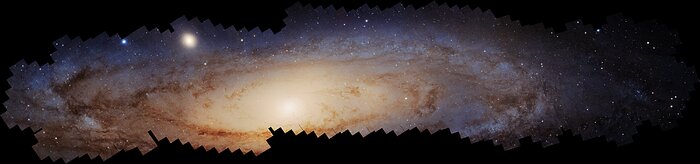 Hubble’s panoramic view of the Andromeda GalaxyJanuary 16, 2025
Hubble M31 PHAT+PHAST MosaicJanuary 16, 2025
 M31 Cepheid Variable Star V1January 15, 2025
 Cepheid Variable Star V1 in Andromeda GalaxyJanuary 15, 2025
 A Cosmic DrawFebruary 7, 2022
 Cosmic Cinnamon BunNovember 16, 2020