Black holes
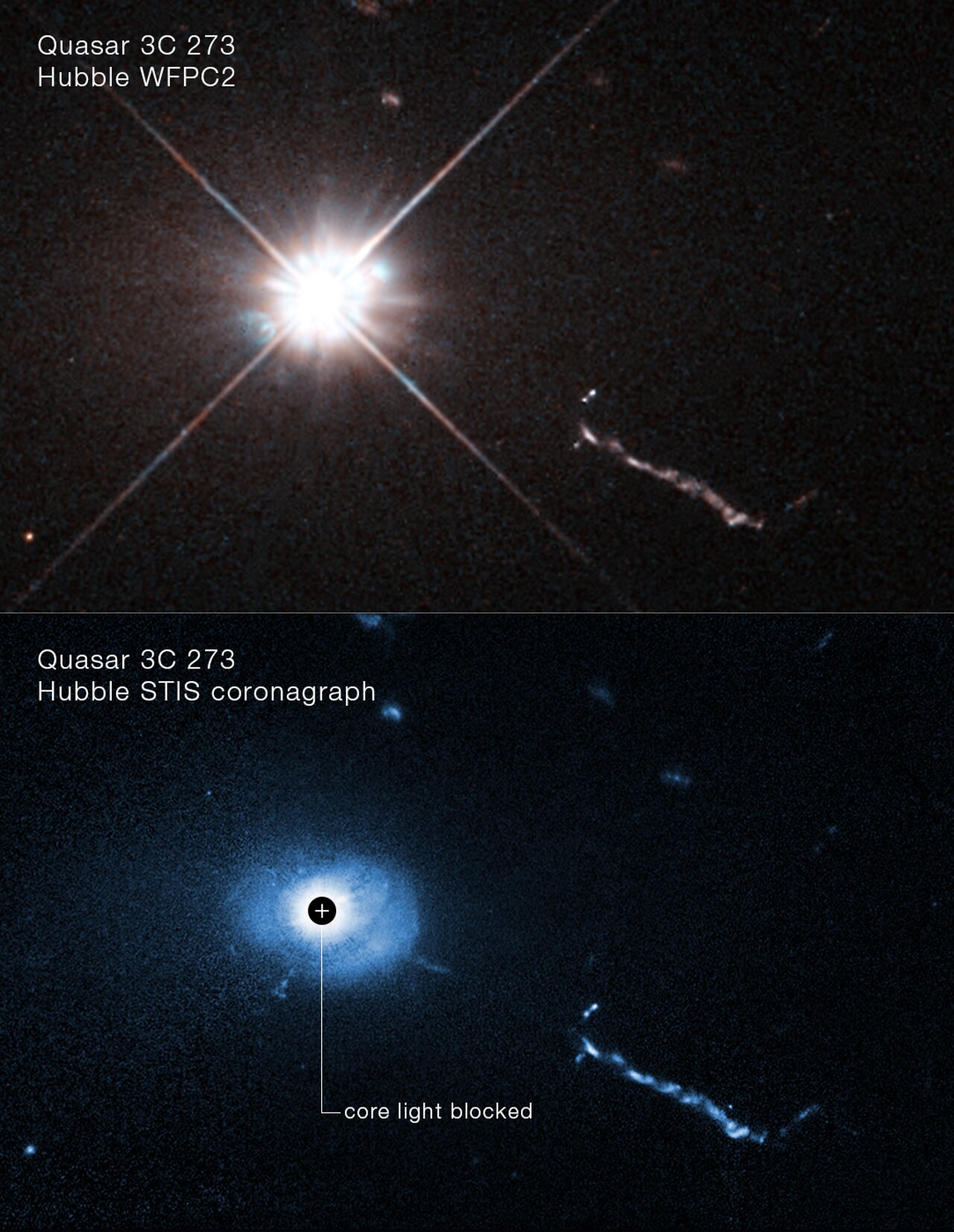
Hubble view of heart of quasar 3C 273
December 5, 2024 · ESA/Hubble
A NASA/ESA Hubble Space Telescope image of the core of quasar 3C 273. A coronagraph on Hubble blocks out the glare coming from the supermassive black hole at the heart of the quasar. This allows astronomers to see unprecedented details near the black hole: weird filaments, lobes, and a mysterious L-shaped structure, probably caused by small galaxies being devoured by the black hole. Located 2.5 billion light-years away, 3C 273 is the first quasar (quasi-stellar object) ever discovered, in 1963.
Image description
Image description : This is a close-up look at the environment around quasar 3C 273 using Hubble’s Space Telescope Imaging Spectrograph (STIS) coronagraph. A black circle blocks the glare of the quasar. Blue-colored filamentary material can be seen near the black hole at the center of its host galaxy. There’s a blue-white smoke-like feature stretching to the 4 o’clock position, an extragalactic jet launched from the quasar.
More black holes
Black Hole TDE AT2024tvd (Hubble + Chandra)May 8, 2025
Black Hole Tidal Disruption EventMay 8, 2025 · video
 Quasar J0742+2704January 13, 2025
Spiral Quasar-host Galaxy J0742+2704January 13, 2025
Quasar 3C 273December 5, 2024
M87September 26, 2024
Enhanced Nova Rate Near the Jet of M87September 26, 2024 · video
Supermassive Black Holes in Hubble Ultra Deep FieldSeptember 17, 2024