Black holes
Enhanced Nova Rate Near the Jet of M87
September 26, 2024 · NASA
This video plots the location of Hubble Space Telescope observations of novae – exploding stars – in the giant elliptical galaxy M87. The galaxy’s most notable feature is a 3,000-light-year-long jet of plasma ejected from a supermassive central black hole. Hubble observations identified numerous novae in the jet’s vicinity. These are identified by red circles that turn white when a nova explodes. Stars seem to explode more frequently in the jet's vicinity. The jet may be pushing interstellar hydrogen toward neighboring stars, enhancing the stellar fueling process that increases the rate of explosions. When the entire galaxy is photometrically surveyed fewer novae appear farther away from the jet.
More black holes
Spiral Quasar-host Galaxy J0742+2704January 13, 2025
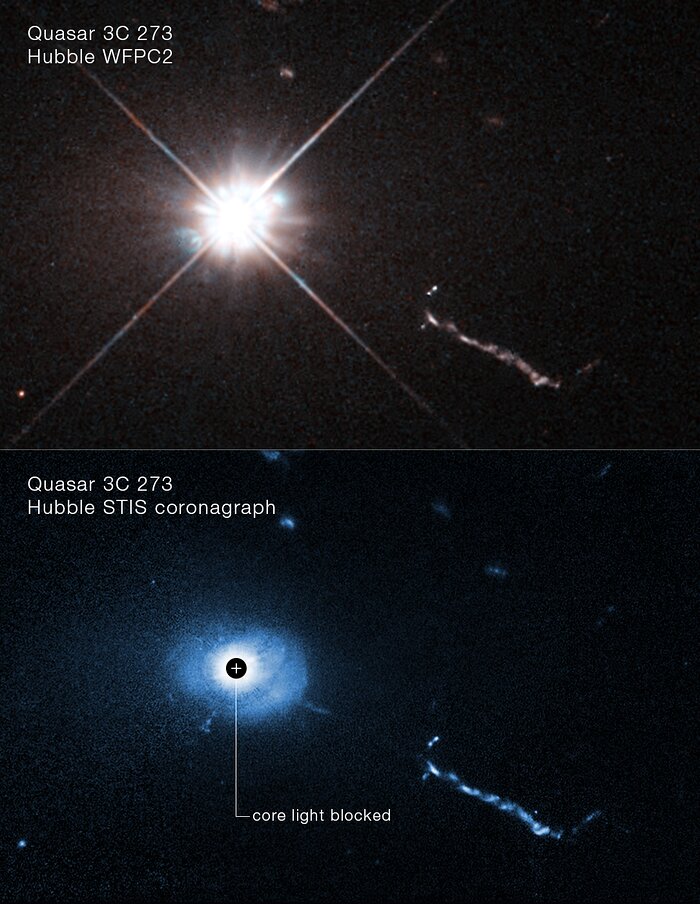 Hubble view of heart of quasar 3C 273December 5, 2024
Quasar 3C 273December 5, 2024
M87September 26, 2024
Supermassive Black Holes in Hubble Ultra Deep FieldSeptember 17, 2024
Black Hole Pair Embedded in Middle of Active Galaxy MCG-03-34-064September 9, 2024
IMBH Candidate in Omega CentauriJuly 10, 2024
Globular Cluster Messier 4 (M4)May 23, 2023