
Nebulae · ESA/Hubble Picture of the Week
The icy blue wings of Hen 2-437
February 8, 2016 · ESA/Hubble · Vulpecula
Zoom to full resolution See where it is in the 3D sky Original on ESA/Hubble ↗
In this cosmic snapshot, the spectacularly symmetrical wings of Hen 2-437 show up in a magnificent icy blue hue. Hen 2-437 is a planetary nebula , one of around 3000 such objects known to reside within the Milky Way.
Located within the faint northern constellation of Vulpecula (The Fox), Hen 2-437 was first identified in 1946 by Rudolph Minkowski , who later also discovered the famous and equally beautiful M2-9 (otherwise known as the Twin Jet Nebula ). Hen 2-437 was added to a catalogue of planetary nebula over two decades later by astronomer and NASA astronaut Karl Gordon Henize .
Planetary nebulae such as Hen 2-437 form when an aging low-mass star — such as the Sun — reaches the final stages of life. The star swells to become a red giant , before casting off its gaseous outer layers into space. The star itself then slowly shrinks to form a white dwarf , while the expelled gas is slowly compressed and pushed outwards by stellar winds. As shown by its remarkably beautiful appearance, Hen 2-437 is a bipolar nebula — the material ejected by the dying star has streamed out into space to create the two icy blue lobes pictured here.
More from Vulpecula and nearby
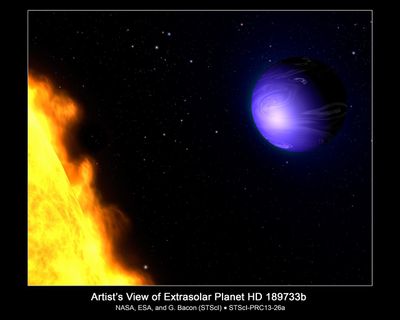 Artist’s View of Extrasolar Planet HD 189733bJuly 11, 2013
 Gravitational Lens Creates Cartoon of Space InvaderMarch 5, 2013
Galaxy Cluster Abell 68March 5, 2013
Gravitationally Lensed Image of Distant Galaxy in Abell 68March 5, 2013
Heritage Image of Galaxy Cluster Abell 68March 5, 2013
Artist’s View of Exoplanet Orbiting the Star HD 189733December 9, 2008
 IRAS 20351+2521April 24, 2008
Hubble Interacting Galaxy IRAS 20351April 24, 2008