
Galaxies · ESA/Hubble Picture of the Week
The loneliest firework display
February 5, 2018 · ESA/Hubble · NGC 1559 · Reticulum
Zoom to full resolution See where it is in the 3D sky Original on ESA/Hubble ↗
Roughly 50 million light-years away lies a somewhat overlooked little galaxy named NGC 1559 . Pictured here by Hubble’s Wide Field Camera 3 , this barred spiral lies in the little-observed southern constellation of Reticulum (The Reticule).
NGC 1559 has massive spiral arms chock-full of star formation , and is receding from us at a speed of about 1300 km/s. The galaxy contains the mass of around ten billion Suns — while this may sound like a lot, that is almost 100 times less massive than the Milky Way. Although NGC 1559 appears to sit near one of our nearest neighbours in the sky — the Large Magellanic Cloud (LMC), this is just a trick of perspective. In reality, NGC 1559 is physically nowhere near the LMC in space — in fact, it truly is a loner, lacking the company of any nearby galaxies or membership of any galaxy cluster .
Despite its lack of cosmic companions, when this lonely galaxy has a telescope pointed in its direction, it puts on quite a show! NGC 1559 has hosted a variety of spectacular exploding stars called supernovae , four of which we have observed — in 1984, 1986, 2005, and 2009 (SN 1984J, 1986L, 2005df [a Type Ia ], and 2009ib [a Type II-P , with an unusually long plateau]).
NGC 1559 may be alone in space, but we are watching and admiring from far away.
More Hubble images of NGC 1559
 The light of knowledgeSeptember 16, 2024
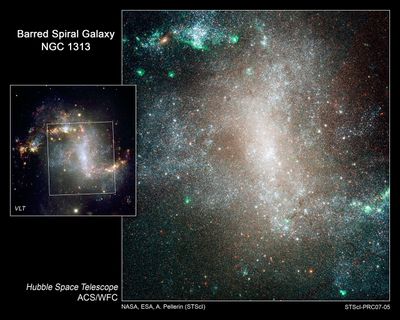 Stellar “Infant Mortality” in Spiral Galaxy NGC 1313January 10, 2007
Barred Spiral Galaxy NGC 1313 – VLTJanuary 10, 2007
Barred Spiral Galaxy NGC 1313 – HSTJanuary 10, 2007
 Zoom-in on NGC 3344February 14, 2018 · video
 The different colours of NGC 3344February 14, 2018 · video
 Pan on NGC 3344February 14, 2018 · video
 A window into the cosmic pastFebruary 12, 2018