
Galaxies
Barred Spiral Galaxy NGC 1313 – HST
January 10, 2007 · NASA · Reticulum
Zoom to full resolution See where it is in the 3D sky Original on NASA ↗
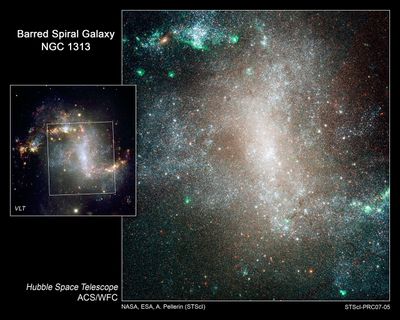
This is a NASA Hubble Space Telescope image of the central region of the barred spiral galaxy NGC 1313. Hubble was used to resolve stars within the galaxy to do a census of various classes of stars distributed across the galaxy. The observations show that hot blue stars (of class B) are widely scattered across the galaxy. This is evidence of "infant mortality" in which the young, so-called open clusters where stars are born, quickly became gravitationally "unglued" and scattered their resident stars into the galaxy. NGC 1313 is 50,000 light-years across and lies 14 million light-years away in the southern constellation of Reticulum.
About the colours
This image is a composite of many separate exposures made by the ACS instrument on the Hubble Space Telescope using several different filters. Two filters were used to sample broad wavelength ranges. One filter was used to sample narrow wavelength emission. The color results from assigning different hues (colors) to each monochromatic image. In this case, the assigned colors are: Blue: F435W (B) Green: F555W (V) Red: F814W (I)
About the data
The Hubble image was created from HST data from proposal 9796 : J. Miller (University of Michigan), G. Fabbiano and A. Zezas (Harvard-Smithsonian Center for Astropysics), P. Kaaret (University of Iowa), J. Grindlay (Harvard University), A. Kong (Massachusetts Institute of Technology), A. King (University of Leicester, UK), M. Ward (University of Durham, UK), V. Kalogera (Northwestern University), M. Krauss (Massachusetts Institute of Technology), M. Garcia (Harvard-Smithsonian Center for Astropysics).
The science team is composed: of A. Pellerin and M. Meyer (STScI), J. Harris (Stewart Observatory), and D. Calzetti (STScI).
Note: Other Hubble ACS data (proposal 9494 ; PI: P. Padovani) and ground-based data (VLT; H. Boffin) were used to fill in the undithered chip gap. The information contained within this section pertains to data from proposal 9797 only.
More Hubble images of NGC 1313
 Stellar “Infant Mortality” in Spiral Galaxy NGC 1313January 10, 2007
Barred Spiral Galaxy NGC 1313 – VLTJanuary 10, 2007
 The light of knowledgeSeptember 16, 2024
 The loneliest firework displayFebruary 5, 2018
SN 1987A 1994-2006February 22, 2007 · video
SN 1987A Debris Sequence 1994-2006February 22, 2007 · video
 Colliding galaxies make love, not warOctober 17, 2006
![Wide view of the Antennae galaxies [ground-based]](https://cdn.esahubble.org/archives/images/thumb700x/heic0615c.jpg) Wide view of the Antennae galaxies [ground-based]October 17, 2006
Wide view of the Antennae galaxies [ground-based]October 17, 2006