
Solar System
Comet-like Filaments Along the Inner Rim of the Helix Nebula’s Gas Ring
May 9, 2003 · NASA · Helix Nebula, NGC 7293 · Aquarius
Zoom to full resolution See where it is in the 3D sky Original on NASA ↗
This cropped version of the Helix Nebula mosaic shows cometary-filaments embedded along a portion of the inner rim of the nebula's red and blue gas ring. At a distance of 650 light-years, the Helix is one of the nearest planetary nebulae to Earth.
The composite picture is a seamless blend of ultra-sharp NASA Hubble Space Telescope (HST) Advanced Camera for Surveys images combined with the wide view of the Mosaic Camera on the National Science Foundation's 0.9-meter telescope at Kitt Peak National Observatory, part of the National Optical Astronomy Observatory, near Tucson, Ariz. Astronomers at the Space Telescope Science Institute (STScI) assembled the images into a mosaic. The mosaic was blended with a wider photograph taken by the Mosaic Camera.
About the data
Hubble data have been superimposed onto ground-based data taken by Travis Rector (NRAO) at the 0.9 meter telescope located on Kitt Peak, Tucson, AZ (NOAO/AURA/NSF).
The HST data are from proposal 9700 . Processed images may be obtained from the Helix MAST web site .
The Hubble Helix Team includes: M. Meixner, H.E. Bond, G. Chapman (STScI), Y.-H. Chu (U. Illinois, Urbana-Champaign), P. Cox (Institut d'Astrophysique Spatiale, France), W. Crothers, L.M. Frattare, R.Gilliland (STScI), M. Guerrero R. Gruendl (U. Illinois, Urbana-Champaign), F. Hamilton, (STScI), R.Hook (STScI/ESO), P. Huggins (New York Univ.), I. Jordan, C.D. Keyes, A. Koekemoer (STScI), K.Kwitter (Williams College), Z.G. Levay, P.R. McCullough, M. Mutchler, K. Noll (STScI), C.R. O'Dell (Vanderbilt Univ.), N. Panagia, M. Reinhart, M. Robberto, K. Sahu, D. Soderblom, L. Stanghellini, C. Tyler, J. Valenti, A. Welty, R. Williams (STScI).
More Hubble images of Helix Nebula, NGC 7293
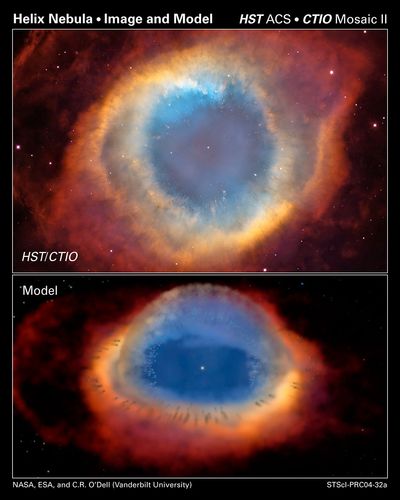 Two Views of a NebulaDecember 16, 2004
Helix Nebula As Seen By Hubble and the Cerro Toledo Inter-American ObservatoryDecember 16, 2004
Helix Nebula ModelDecember 16, 2004
The Helix Nebula: a Gaseous Envelope Expelled By a Dying StarDecember 16, 2004
Iridescent Glory of Nearby Helix NebulaMay 9, 2003
 Location of Detail and ACS Exposures on Full ImageMay 9, 2003
Close-Up of the Helix NebulaMay 9, 2003
Close-Up of the Helix NebulaMay 9, 2003