
Nebulae
The Helix Nebula: a Gaseous Envelope Expelled By a Dying Star
December 16, 2004 · NASA · Helix Nebula, NGC 7293 · Aquarius
Zoom to full resolution See where it is in the 3D sky Original on NASA ↗
This composite image is a view of the colorful Helix Nebula taken with the Advanced Camera for Surveys aboard NASA's Hubble Space Telescope and the Mosaic II Camera on the 4-meter telescope at Cerro Tololo Inter-American Observatory in Chile. The object is so large that both telescopes were needed to capture a complete view. The Helix is a planetary nebula, the glowing gaseous envelope expelled by a dying, sun-like star. The Helix resembles a simple doughnut as seen from Earth. But looks can be deceiving. New evidence suggests that the Helix consists of two gaseous disks nearly perpendicular to each other.
One possible scenario for the Helix's complex structure is that the dying star has a companion star. One disk may be perpendicular to the dying star's spin axis, while the other may lie in the orbital plane of the two stars. The Helix, located 690 light-years away, is one of the closest planetary nebulas to Earth.
The Hubble images were taken on November 19, 2002; the Cerro Tololo images on Sept. 17-18, 2003.
About the colours
Blue: F502N ([O III]) Green: c6009 (H-alpha) and kc6014 ([O III]) Red: F658N (H-alpha)
About the data
The HST data are from proposal 9700 . Processed images may be obtained from the Helix MAST web site.
The Hubble Helix Team includes: M. Meixner, H.E. Bond, G. Chapman (STScI), Y.-H. Chu (U. Illinois, Urbana-Champaign), P. Cox (Institut d'Astrophysique Spatiale, France), W. Crothers, L.M. Frattare, R.Gilliland (STScI), M. Guerrero R. Gruendl (U. Illinois, Urbana-Champaign), F. Hamilton, (STScI), R.Hook (STScI/ESO), P. Huggins (New York Univ.), I. Jordan, C.D. Keyes, A. Koekemoer (STScI), K.Kwitter (Williams College), Z.G. Levay, P.R. McCullough, M. Mutchler, K. Noll (STScI), C.R. O'Dell (Vanderbilt University), N. Panagia, M. Reinhart, M. Robberto, K. Sahu, D. Soderblom, L. Stanghellini, C. Tyler, J. Valenti, A. Welty, R. Williams (STScI).
The CTIO data were taken by C.R. O'Dell (Vanderbilt University) and L.M. Frattare (STScI). The science team includes C.R. O'Dell (Vanderbilt University), P.R. McCullough and M. Meixner (STScI).
More Hubble images of Helix Nebula, NGC 7293
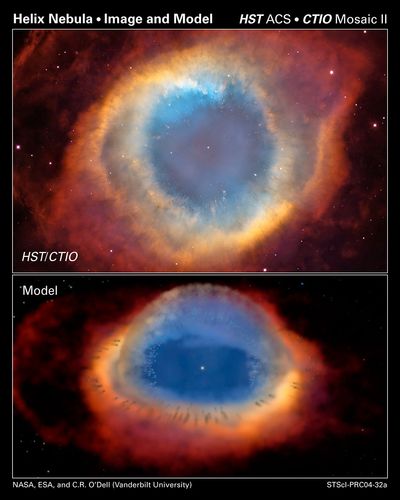 Two Views of a NebulaDecember 16, 2004
Helix Nebula As Seen By Hubble and the Cerro Toledo Inter-American ObservatoryDecember 16, 2004
Helix Nebula ModelDecember 16, 2004
Iridescent Glory of Nearby Helix NebulaMay 9, 2003
Comet-like Filaments Along the Inner Rim of the Helix Nebula’s Gas RingMay 9, 2003
 Location of Detail and ACS Exposures on Full ImageMay 9, 2003
Close-Up of the Helix NebulaMay 9, 2003
Close-Up of the Helix NebulaMay 9, 2003