
Deep fields & lensing
Individual Galaxy Details
September 21, 2006 · NASA · HUDF Galaxies · Fornax
Zoom to full resolution See where it is in the 3D sky Original on NASA ↗
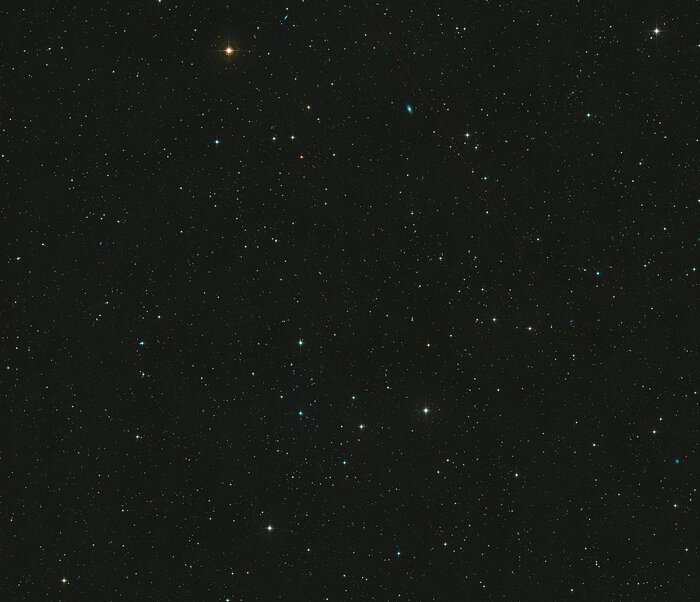
Astronomers analyzing two of the deepest views of the cosmos made with NASA's Hubble Space Telescope have uncovered a gold mine of galaxies, more than 500 that existed less than a billion years after the Big Bang. These galaxies thrived when the cosmos was less than 7 percent of its present age of 13.7 billion years. This sample, of which 28 are seen here, represents the most comprehensive compilation of galaxies in the early universe. The galaxies appear red because of their tremendous distance from Earth. The blue light from their young stars took nearly 13 billion years to arrive at Earth. During the journey, the blue light was shifted to red light due to the expansion of space.
About the colours
Blue: F435W (B) Green: F606W (V) + F775W (i) Red: F850LP (z)
About the data
The science team for this release is: R. Bouwens and G. Illingworth (University of California, Santa Cruz), J. Blakeslee (Washington State University), and M. Franx (Leiden Observatory).
This image was created from HST data from the following proposal: 9978 : HUDF Team (STScI).
The science teams are: • A.J. Bunker (Univ.of Exeter U.K./ Inst. of Astrophysics, Univ. of Cambridge, U.K.), E.R. Stanway (Inst. of Astrophysics, Univ. of Cambridge, U.K.), R.S. Ellis (California Inst. of Tech.), and R.G. McMahon (Inst. of Astrophysics, Univ. of Cambridge, U.K.) • H. Yan (Spitzer Science Center, California Inst. of Tech.) and R.A. Windhorst (Arizona State Univ.) • M. Stiavelli, S.M. Fall, and N. Panagia (STScI) • R.J. Bouwens and G.D. Illingworth (Univ. of California, Santa Cruz), R.I. Thompson (Steward Obs./Univ. of Arizona), J.P. Blakeslee (Johns Hopkins Univ.), M.E. Dickinson (National Optical Astronomy Obs.), T.J. Broadhurst (The Hebrew Univ., Israel), D.J. Eisenstein and X. Fan (Steward Obs./Univ. of Arizona), M. Franx (Leiden Observatory, Netherlands), G. Meurer (Johns Hopkins Univ.), and P. van Dokkum (Yale Univ.) • S. Malhotra, J.E. Rhoads, N. Pirzkal and C. Xu (Space Telescope Science Inst.)
More from Fornax and nearby
 Galaxy MXDFz4.4 (Hubble and Webb Image)June 23, 2026
Supermassive Black Holes in Hubble Ultra Deep FieldSeptember 17, 2024
 Same galaxy, different filtersNovember 13, 2023
 Hubble Spies a Long-Armed GalaxyDecember 26, 2022
 Eye of the GalaxyMarch 14, 2022
 One of a PairNovember 29, 2021
 Wide-Field View of GAL-CLUS-022058sSeptember 23, 2021
“Molten Ring” GalaxySeptember 23, 2021