
Star clusters
Faintest Stars in Globular Cluster NGC 6397
August 17, 2006 · NASA · Ara
Zoom to full resolution See where it is in the 3D sky Original on NASA ↗
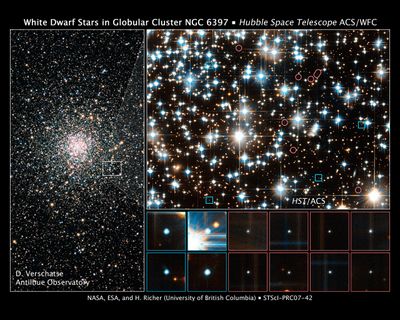
Looking like glittering jewels, the stars in this Hubble Space Telescope image at left are part of the ancient globular star cluster NGC 6397. Scattered among these brilliant stars are extremely faint stars. Hubble's Advanced Camera for Surveys has taken a census of the cluster stars, uncovering the faintest stars ever seen in a globular cluster. Globular clusters are spherical concentrations of hundreds of thousands of old stars.
The Advanced Camera found the faintest red dwarf stars (26th magnitude), which are cooler and much lower in mass than our Sun, and the dimmest white dwarfs (28th magnitude), the burned-out relics of normal stars. The light from the dimmest white dwarfs is equal to the light produced by a birthday candle on the Moon as seen from Earth.
The image at lower right shows the faintest red dwarf star (the red dot within the red circle) spied by Hubble.
The image at upper right pinpoints one of the dim white dwarfs (the blue dot within the blue circle) seen by Hubble. The white dwarf has been cooling for billions of years. It is so cool that instead of looking red, it has undergone a chemical change in its atmosphere that makes it appear blue.
The images were taken with visual and red filters. NGC 6397, one of the closest globular clusters to Earth, is 8,500 light-years away in the southern constellation Ara.
The data for these images were obtained in March and April 2005.
About the colours
This image is a composite of many separate exposures made by the ACS instrument on the Hubble Space Telescope using several different filters. Three filters sample broad wavelength ranges, one isolates the light of hydrogen. The color results from assigning different hues (colors) to each monochromatic image. In this case, the assigned colors are: Cyan: F606W (V) Orange: F814W (I)
About the data
This image was created from HST data from proposal 10424 : H. Richer (University of British Columbia), P. Guhathakurta (University of California, Santa Cruz), R.M. Rich (University of California, Los Angeles), J. Anderson (Rice University), G. Fahlman (National Research Council/Herzberg Institute of Astrophysics, Canada), B. Gibson (Swineburne University of Technology), B. Hansen (University of California, Los Angeles), J. Hurley (Monash University, Australia), J. Kalirai (University of California, Santa Cruz), I. King (University of Washington, Seattle), M. Shara (American Museum of Natural History), and P. Stetson (National Research Council/Herzberg Institute of Astrophysics, Canada).
The science team comprises: H. Richer (University of British Columbia), J. Anderson (Rice University), J. Brewer and S.Davis (University of British Columbia), G. Fahlman (National Research Council/Herzberg Institute of Astrophysics, Canada), B. Hansen (University of California, Los Angeles), J. Hurley (Monash University, Australia), J. Kalirai (University of California, Santa Cruz), I. King (University of Washington, Seattle), D. Reitzel (University of California, Los Angeles), R.M. Rich (University of California, Los Angeles), M. Shara (American Museum of Natural History), and P. Stetson (National Research Council/Herzberg Institute of Astrophysics, Canada).
More Hubble images of NGC 6397
NGC 6397February 11, 2021
NGC 6397April 4, 2018
 Hubble Finds Young White Dwarfs on the Fast TrackDecember 4, 2007
Ground-based Image of Globular Cluster NGC 6397December 4, 2007
Hubble Space Telescope Image of Globular Cluster NGC 6397December 4, 2007
White Dwarfs in NGC 6397 (Hubble)December 4, 2007
Globular Cluster NGC 6397August 17, 2006
Faint White Dwarf Star in Globular Cluster NGC 6397August 17, 2006