
Star clusters
NGC 6397
April 4, 2018 · NASA · Ara
Zoom to full resolution See where it is in the 3D sky Original on NASA ↗
Hubble’s View of Dazzling Globular Star Cluster NGC 6397
This ancient stellar jewelry box, a globular cluster called NGC 6397, glitters with the light from hundreds of thousands of stars.
Astronomers used the Hubble Space Telescope to gauge the distance to this brilliant stellar grouping, obtaining the first precise measurement ever made to an ancient globular cluster.
The new measurement sets the cluster’s distance at 7,800 light-years away, with just a 3 percent margin of error. NGC 6397 is one of the closest globular clusters to Earth.
By measuring an accurate distance to NGC 6397, astronomers then calculated a precise age for the cluster. The cluster is 13.4 billion years old, which means it was born shortly after the big bang. NGC 6397 is one of about 150 globular clusters that orbit outside of our Milky Way galaxy’s comparatively younger starry disk. These spherical, densely packed swarms of hundreds of thousands of stars are our galaxy’s first homesteaders.
The cluster’s blue stars are near the end of their lives. These stars have used up their hydrogen fuel that makes them shine. Now they are converting helium to energy in their cores, which fuses at a higher temperature and appears blue.
The reddish glow is from red giant stars that have consumed their hydrogen fuel and have expanded in size.
The myriad small white objects include stars like our Sun.
This image is composed of a series of observations taken from July 2004 to June 2005 with Hubble’s Advanced Camera for Surveys. The research team used Hubble’s Wide Field Camera 3 to measure the distance to the cluster.
About the colours
These images are a composite of separate exposures acquired by the ACS/WFC instrument on the Hubble Space Telescope. Several filters were used to sample narrow wavelength ranges. The color results from assigning different hues (colors) to each monochromatic (grayscale) image associated with an individual filter. In this case, the assigned colors are: Blue: F425W Red: F625W
About the data
The HST observations used in the image include those from program 10257 (J. Anderson/STScI).
The HST observations from the study include those from program 13817 (T. Brown/STScI) taken with WFC3 between September 2014 and September 2016 using filters F336W, F467M, F547M, F606W, and F850LP.
More Hubble images of NGC 6397
NGC 6397February 11, 2021
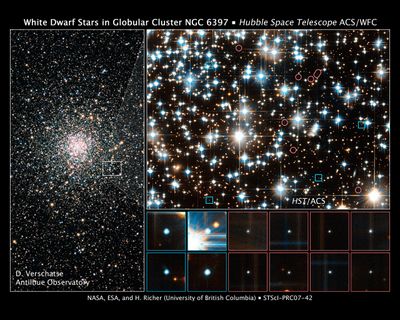 Hubble Finds Young White Dwarfs on the Fast TrackDecember 4, 2007
Ground-based Image of Globular Cluster NGC 6397December 4, 2007
Hubble Space Telescope Image of Globular Cluster NGC 6397December 4, 2007
White Dwarfs in NGC 6397 (Hubble)December 4, 2007
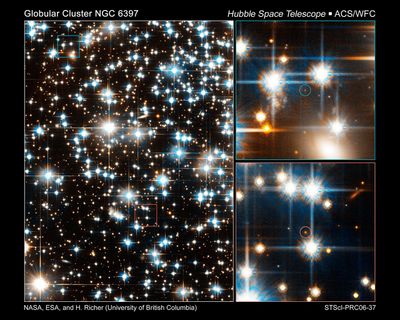 Faintest Stars in Globular Cluster NGC 6397August 17, 2006
Globular Cluster NGC 6397August 17, 2006
Faint White Dwarf Star in Globular Cluster NGC 6397August 17, 2006