
Galaxies
NASA’s Great Observatories Celebrate the International Year of Astronomy
February 10, 2009 · NASA · M101, NGC 5457, The Pinwheel Galaxy · Ursa Major
Zoom to full resolution See where it is in the 3D sky Original on NASA ↗
In 1609, Galileo improved the newly invented telescope, turned it toward the heavens, and revolutionized our view of the universe. In celebration of the 400th anniversary of this milestone, 2009 has been designated as the International Year of Astronomy.
Today, NASA's Great Observatories are continuing Galileo's legacy with stunning images and breakthrough science from the Hubble Space Telescope, the Spitzer Space Telescope, and the Chandra X-ray Observatory.
While Galileo observed the sky using visible light seen by the human eye, technology now allows us to observe in many wavelengths, including Spitzer's infrared view and Chandra's view in X-rays. Each wavelength region shows different aspects of celestial objects and often reveals new objects that could not otherwise be studied.
This image of the spiral galaxy Messier 101 is a composite of views from Spitzer, Hubble, and Chandra.
• The red color shows Spitzer's view in infrared light. It highlights the heat emitted by dust lanes in the galaxy where stars can form.
• The yellow color is Hubble's view in visible light. Most of this light comes from stars, and they trace the same spiral structure as the dust lanes.
• The blue color shows Chandra's view in X-ray light. Sources of X-rays include million-degree gas, exploded stars, and material colliding around black holes.
Such composite images allow astronomers to see how features seen in one wavelength match up with those seen in another wavelength. It's like seeing with a camera, night vision goggles, and X-ray vision all at once.
In the four centuries since Galileo, astronomy has changed dramatically. Yet our curiosity and quest for knowledge remain the same. So, too, does our wonder at the splendor of the universe.
The International Year of Astronomy Great Observatories Image Unveiling is supported by the NASA Science Mission Directorate Astrophysics Division. The project is a collaboration between the Space Telescope Science Institute, the Spitzer Science Center, and the Chandra X-ray Center.
About the colours
Red: 85 sec/pixel (IRAC) and 200 sec/pixel (MIPS 24 micron) Yellow/green: F435W (B), F555W (V)), and F814W (I) Blue: 0.45 - 1.00 keV and 1.00 - 2.00 keV
About the data
Spitzer data (right-top): The science team for the Spitzer data include K. Gordon (STScI), C. Engelbracht, G. Rieke, K. Misselt, and J.-D. Smith (University of Arizona), and R. Kennicutt (University of Cambridge).
Hubble data (right-center): This image was created from HST data from the following proposals: 9490 : K. Kuntz (Johns Hopkins University) 9492 : F. Bresolin (University of Hawaii) 5210 : J. Trauger (Jet Propulsion Laboratory) 5397 : J. Mould (NOAO) 6829 : Y.-C. Chu (University of Illinois, Urbana) The Hubble exposures have been superimposed onto ground-based images, visible at the edge of the image, taken at the Canada-France-Hawaii Telescope in Hawaii, and at the 0.9-meter telescope at Kitt Peak National Observatory, part of the National Optical Astronomy Observatory in Arizona.
Chandra data (right-bottom): The science team was led by K. Kuntz (Johns Hopkins University).
More Hubble images of M101, NGC 5457, The Pinwheel Galaxy
Hubble Image of M101February 10, 2009
 Construction of the Great Observatories M101 ImageFebruary 10, 2009
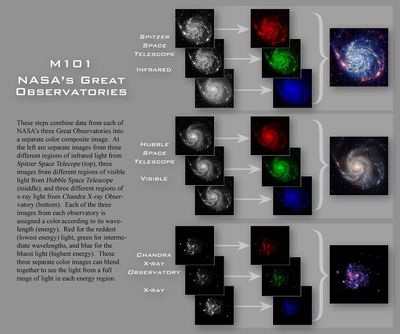 Construction of the Individual Great Observatories M101 ImagesFebruary 10, 2009
Hubble’s Largest Galaxy Portrait Offers a New High-Definition ViewFebruary 28, 2006
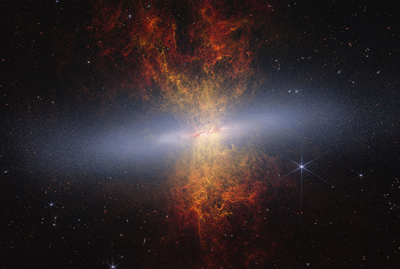 M82 Cigar Galaxy (Webb + Hubble)June 23, 2026
 Cloud 9, Starless Gas CloudJanuary 5, 2026
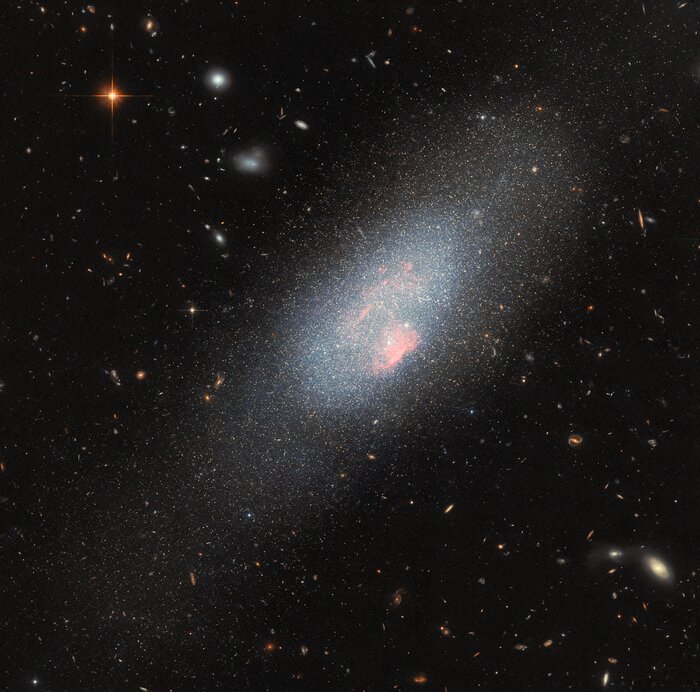 Massive stars make their markDecember 8, 2025
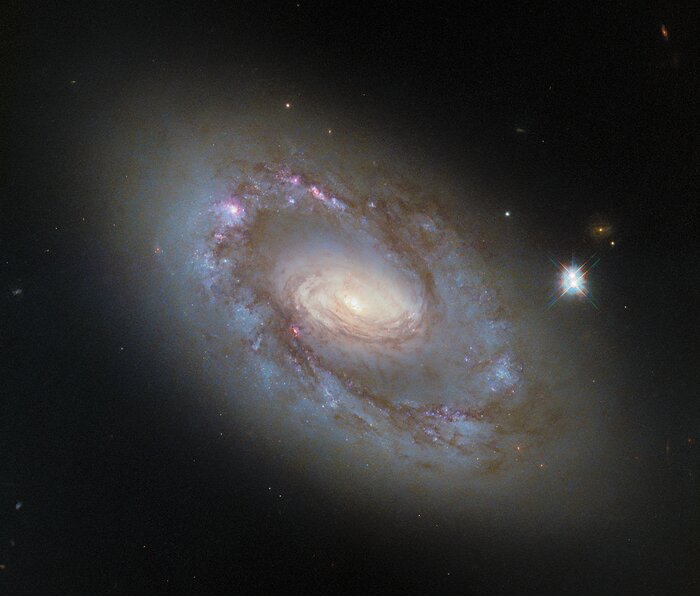 Revisiting an unusual spiralNovember 3, 2025