
Galaxies
Construction of the Great Observatories M101 Image
February 10, 2009 · NASA · M101, NGC 5457, The Pinwheel Galaxy · Ursa Major
Zoom to full resolution See where it is in the 3D sky Original on NASA ↗
These steps combine data from NASA's three Great Observatories into a single color composite image. At the left are separate images from three different regions of infrared light from the Spitzer Space Telescope, three images from different regions of visible light from the Hubble Space Telescope, and three different regions of x-ray light from the Chandra X-ray Observatory. The three images from each observatory are combined into a single black and white image representing the light from that part of the spectrum. Each of these images is assigned a color: red for infrared light, yellow for visible light, and blue for x-ray light. These three separate color images can blend together to see the light from a very broad range of light energy in one image.
About the data
Spitzer data: The science team for the Spitzer data include K. Gordon (STScI), C. Engelbracht, G. Rieke, K. Misselt, and J.-D. Smith (University of Arizona), and R. Kennicutt (University of Cambridge).
Hubble data: This image was created from HST data from the following proposals: 9490 : K. Kuntz (Johns Hopkins University) 9492 : F. Bresolin (University of Hawaii) 5210 : J. Trauger (Jet Propulsion Laboratory) 5397 : J. Mould (NOAO) 6829 : Y.-C. Chu (University of Illinois, Urbana) The Hubble exposures have been superimposed onto ground-based images, visible at the edge of the image, taken at the Canada-France-Hawaii Telescope in Hawaii, and at the 0.9-meter telescope at Kitt Peak National Observatory, part of the National Optical Astronomy Observatory in Arizona.
Chandra data: The science team was led by K. Kuntz (Johns Hopkins University).
More Hubble images of M101, NGC 5457, The Pinwheel Galaxy
 NASA’s Great Observatories Celebrate the International Year of AstronomyFebruary 10, 2009
Hubble Image of M101February 10, 2009
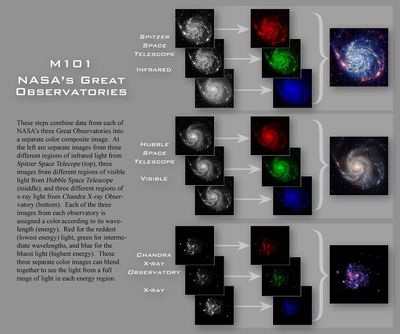 Construction of the Individual Great Observatories M101 ImagesFebruary 10, 2009
Hubble’s Largest Galaxy Portrait Offers a New High-Definition ViewFebruary 28, 2006
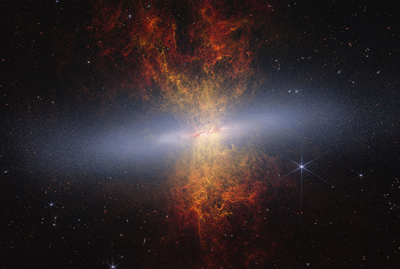 M82 Cigar Galaxy (Webb + Hubble)June 23, 2026
 Cloud 9, Starless Gas CloudJanuary 5, 2026
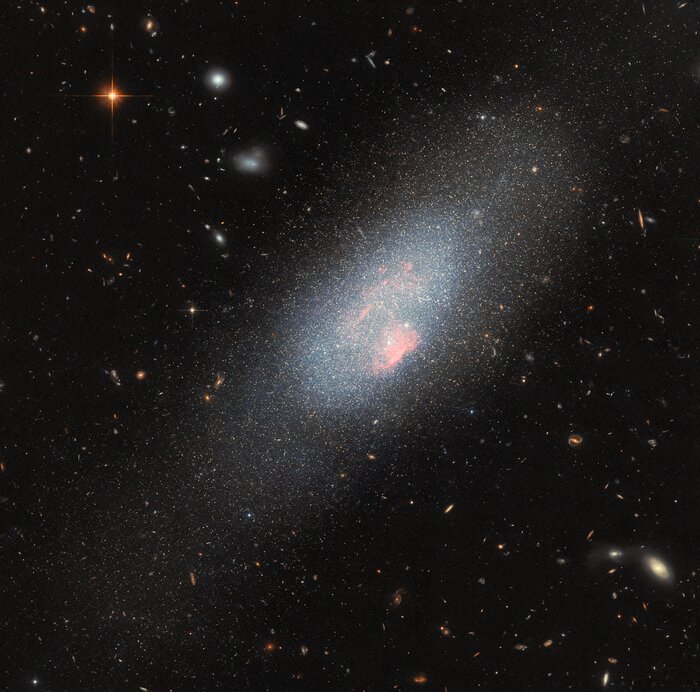 Massive stars make their markDecember 8, 2025
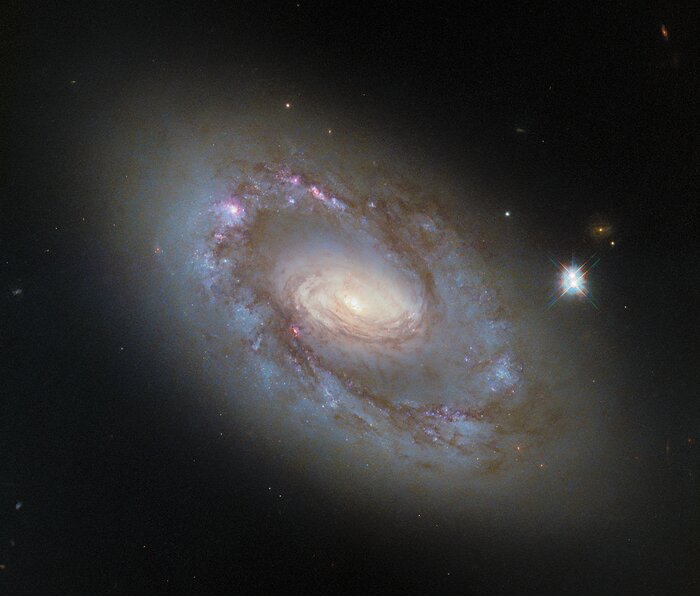 Revisiting an unusual spiralNovember 3, 2025