
Galaxies
NASA’s Great Observatories Examine the Galactic Center Region
November 10, 2009 · NASA · Sagittarius
Zoom to full resolution See where it is in the 3D sky Original on NASA ↗
In celebration of the International Year of Astronomy 2009, NASA's Great Observatories – the Hubble Space Telescope, the Spitzer Space Telescope, and the Chandra X-ray Observatory – have collaborated to produce an unprecedented image of the central region of our Milky Way galaxy.
In this spectacular image, observations using infrared light and X-ray light see through the obscuring dust and reveal the intense activity near the galactic core. Note that the center of the galaxy is located within the bright white region to the right of and just below the middle of the image. The entire image width covers about one-half a degree, about the same angular width as the full moon.
Each telescope's contribution is presented in a different color:
– Yellow represents the near-infrared observations of Hubble. These observations outline the energetic regions where stars are being born as well as reveal hundreds of thousands of stars.
– Red represents the infrared observations of Spitzer. The radiation and winds from stars create glowing dust clouds that exhibit complex structures from compact, spherical globules to long, stringy filaments.
– Blue and violet represent the X-ray observations of Chandra. X-rays are emitted by gas heated to millions of degrees by stellar explosions and by outflows from the supermassive black hole in the galaxy's center. The bright blue blob on the left side is emission from a double star system containing either a neutron star or a black hole.
When these views are brought together, this composite image provides one of the most detailed views ever of our galaxy's mysterious core.
About the data
Spitzer Data: The Spitzer Space Telescope data were courtesy of NASA, Jet Propulsion Laboratory, and S. Stolovy (Spitzer Science Center/California Institute of Technology).
Hubble Data: The Hubble component was from the HST proposal 11120 : Q.D. Wang (University of Massachusetts, Amherst), S. Stolovy (Caltech), C. Lang (University of Iowa), A. Cotera (SETI Institute), M. Muno (Caltech), M. Morris (University of California, Los Angeles), D. Calzetti (University of Massachusetts, Amherst), S. Ramirez (Caltech), and G. Schneider (University of Arizona).
Chandra Data: The science team was led by Q.D. Wang (University of Massachusetts, Amherst). Image courtesy of NASA/CXC/UMass/Q.D. Wang et al.
More Hubble images of Galactic Center
Milky Way Nuclear Star ClusterMarch 31, 2016
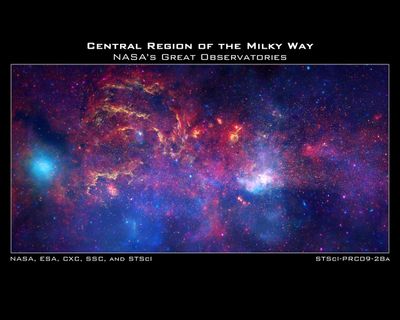 NASA’s Great Observatories Examine the Galactic Center Region (With Title)November 10, 2009
 NASA’s Great Observatories Present Unique Views of the Center of the Milky WayNovember 10, 2009
Galactic Center Region in Infrared from SpitzerNovember 10, 2009
Galactic Center Region in Near-Infrared from HubbleNovember 10, 2009
Galactic Center Region in X-rays from ChandraNovember 10, 2009
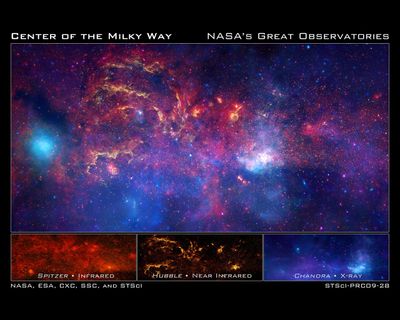 Views of the Galactic Center Region from NASA’s Great ObservatoriesNovember 10, 2009
Hubble-Spitzer Color Mosaic of the Galactic CenterJanuary 5, 2009