
Star clusters
Milky Way Nuclear Star Cluster
March 31, 2016 · NASA · Galactic Center · Sagittarius
Zoom to full resolution See where it is in the 3D sky Original on NASA ↗
Peering deep into the heart of our Milky Way galaxy, NASA's Hubble Space Telescope reveals a rich tapestry of more than half a million stars. Except for a few blue, foreground stars, the stars are part of the Milky Way's nuclear star cluster, the most massive and densest star cluster in our galaxy. So packed with stars, it is equivalent to having a million suns crammed into the volume of space between us and our closest stellar neighbor, Alpha Centauri, 4.3 light-years away. At the very hub of our galaxy, this star cluster surrounds the Milky Way's central supermassive black hole, which is about 4 million times the mass of our sun.
Astronomers used Hubble's infrared vision to pierce through the dust in the disk of our galaxy that obscures the star cluster. In this image, scientists translated the infrared light, which is invisible to human eyes, into colors our eyes can see. The red stars are either embedded or shrouded by intervening dust. Extremely dense clouds of gas and dust are seen in silhouette, appearing dark against the bright background stars. These clouds are so thick that even Hubble's infrared capability could not penetrate them.
Hubble's sharp vision allowed astronomers to measure the movements of the stars over four years. Using this information, scientists were able to infer important properties such as the mass and structure of the nuclear star cluster. The motion of the stars may also offer a glimpse into how the star cluster was formed – whether it was built up over time by globular star clusters that happen to fall into the galaxy's center, or from gas spiraling in from the Milky Way's disk to form stars at the core.
This picture, spanning 50 light-years across, is a mosaic stitched from nine separate images from Hubble's Wide Field Camera 3. The center of the Milky Way is located 27,000 light-years away. The "snowstorm" of stars in the image is just the tip of the iceberg: Astronomers estimate that about 10 million stars in this cluster are too faint to be captured in this image.
About the colours
This image is a composite of separate exposures acquired by the WFC3/IR instrument. Several filters were used to sample various wavelengths. The color results from assigning different hues (colors) to each monochromatic (grayscale) image associated with an individual filter. In this case, the assigned colors are: Blue: F127M (H2O/CH4 continuum) Green: F139M (H2O/CH4 line) Red: F153M (H2O and NH3)
About the data
The HST data were taken from proposals 13049 , 12663 , and 12182 PI: T. Do (UCLA) and 11671 PI: A. Ghez (UCLA). The science team comprises T. Do, A. Ghez, and M. Morris (UCLA), R. Schodel (Instituto de Astrofísica de Andalucia), J. Lu (University of Hawaii), W. Clarkson (University of Michigan), D. Merritt (RIT), B. Hansen and S. Yelda (UCLA), J. Bullock (University of California, Irvine), J. Anderson (STScI), L. Meyer, E. Mills, and N. McCrady (UCLA), and J.-U. Pott (Max Planck Insititue for Astronomy, Heidelberg).
More Hubble images of Galactic Center
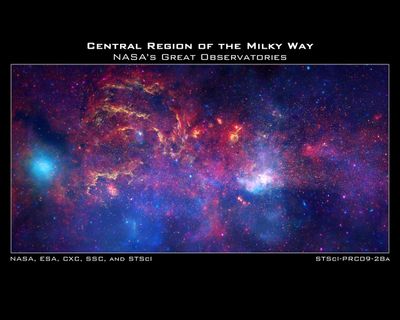 NASA’s Great Observatories Examine the Galactic Center Region (With Title)November 10, 2009
NASA’s Great Observatories Examine the Galactic Center RegionNovember 10, 2009
 NASA’s Great Observatories Present Unique Views of the Center of the Milky WayNovember 10, 2009
Galactic Center Region in Infrared from SpitzerNovember 10, 2009
Galactic Center Region in Near-Infrared from HubbleNovember 10, 2009
Galactic Center Region in X-rays from ChandraNovember 10, 2009
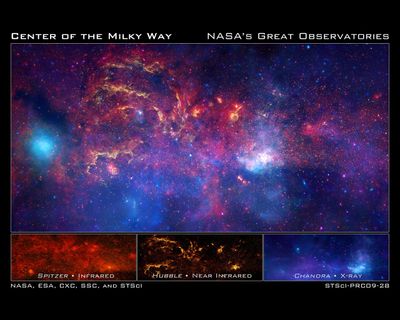 Views of the Galactic Center Region from NASA’s Great ObservatoriesNovember 10, 2009
Hubble-Spitzer Color Mosaic of the Galactic CenterJanuary 5, 2009