
Black holes
CLASH Survey Brightest Cluster Galaxies and Simulations
August 6, 2015 · NASA · MACS J1931, and MACS J1532
In this comparison of actual observations with simulations, the top images show Hubble observations of the density of gas in the central portion of two galaxies. The bottom images are computer simulations that are remarkably similar to the Hubble observations. Knots of star formation in the two galaxies show how gas falling into a galaxy's center is controlled by jets from the central black hole.
About the data
Data for galaxies taken with the WFC3/UVIS instrument were obtained as part of the CLASH proposal: 12456 , PI: M. Postman (STScI) et al. Data for galaxies taken with the ACS/SBC instrument were obtained from proposal: 12220 , PI: R. Mittal (Max Planck Institute for Gravitational Physics) et al.
The WFC3/UVIS BCG science team comprises: M. Donahue and T. Connor (Michigan State University), K. Fogarty (STScI), Y. Li (University of Michigan, Ann Arbor), M. Voit (Michigan State University), M. Postman and A. Koekemoer (STScI), J. Moustakas (Siena College, NY), L. Bradley (STScI), and H. Ford (JHU).
The ACS/SBC BCG science team comprises: G. Tremblay (Yale University/ESO), C. O’Dea and S. Baum (University of Manitoba/RIT), R. Mittal (RIT/Max Planck Institute for Gravitational Physics), M. McDonald (Kavli Institute/MIT), F. Combes (Observatoire de Paris/CNRS), Y. Li (University of Michigan, Ann Arbor), B. McNamara (Waterloo University, Ontario/Harvard-Smithsonian Center for Astrophysics), M. Bremer (University of Bristol, UK), T. Clarke (Naval Research Laboratory), M. Donahue (Michigan State University), A. Edge (Durham University), A. Fabian (Institute of Astronomy), S. Hamer (Observatoire de Paris/CNRS), M. Hogan (Waterloo University, Ontario), J. Oonk (Netherlands Institute for Radio Astronomy), A. Quillen (University of Rochester), J. Sanders (Max Planck Institute for Extraterrestrial Physics), P. Salomé (Observatoire de Paris/CNRS), and M. Voit (Michigan State University).
More black holes
 Size of Smith Cloud on the SkyJanuary 28, 2016
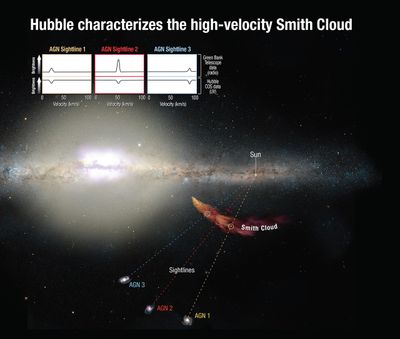 Hubble Characterizes the High-Velocity Smith CloudJanuary 28, 2016
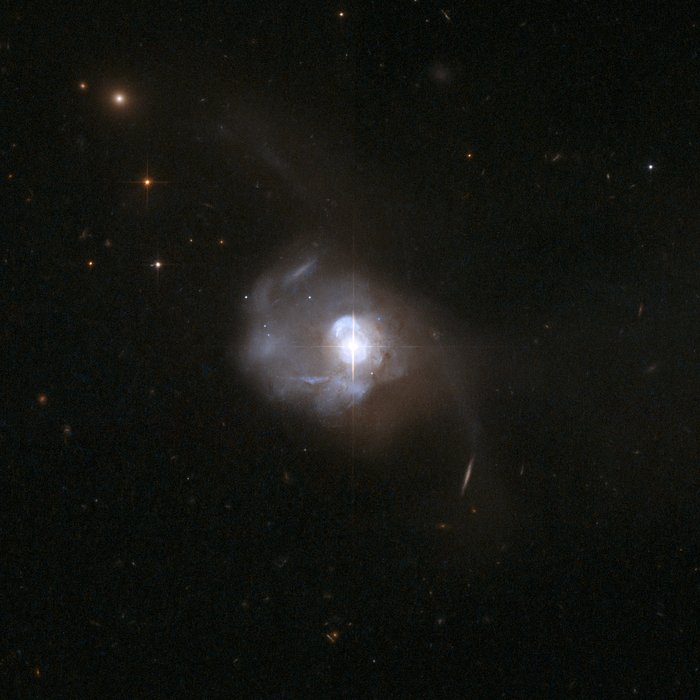 Markarian 231, host galaxy of double black holeAugust 28, 2015
Quasar Host Galaxy Markarian 231August 27, 2015
Galaxy MACS J1931August 6, 2015
Galaxy MACS J1532August 6, 2015
Simulation for Galaxy MACS J1532August 6, 2015
Simulation for Galaxy MACS J1931August 6, 2015