
Illustrations
Artist’s View of a Binary Black Hole
August 27, 2015 · NASA
This artistic illustration is of a binary black hole found in the center of the nearest quasar host galaxy to Earth, Markarian 231. Like a pair of whirling skaters, the black-hole duo generates tremendous amounts of energy that makes the core of the host galaxy outshine the glow of the galaxy's population of billions of stars. Quasars have the most luminous cores of active galaxies and are often fueled by galaxy collisions.
Hubble observations of the ultraviolet light emitted from the nucleus of the galaxy were used to deduce the geometry of the disk, and astronomers were surprised to see light diminishing close to the central black hole. They deduced that a smaller companion black hole has cleared out a donut hole in the accretion disk, and the smaller black hole has its own mini-disk with an ultraviolet glow.
About the data
The Hubble image was created using HST data from proposal 10592 : A. Evans (University of Virginia, Charlottesville/NRAO/Stony Brook University). The galaxy pair was imaged with the ACS/WFC instrument with filters F435W (B) and F814W (I) on May 10, 2002.
The science team comprises: C.-S. Yan and Y. Lu (National Astronomical Observatories, Chinese Academy of Sciences, Beijing), X. Dai (University of Oklahoma), and Q. Yu (Peking University).
More illustrations
 Stereo image of the Veil NebulaSeptember 24, 2015
 Still from Hubblecast episode 87: The many mysteries of PlutoSeptember 23, 2015
 Ode to Hubble shortlist announcedSeptember 9, 2015
 Artist's concept of double black holeAugust 28, 2015
 Still from: Hubblecast episode 86: the wings of the Twin Jet NebulaAugust 26, 2015
 Scenario for Homeless Supernovae (Artist’s Illustration)August 13, 2015
 Star Formation Triggered by Black-Hole Jets (Artist’s Concept)August 6, 2015
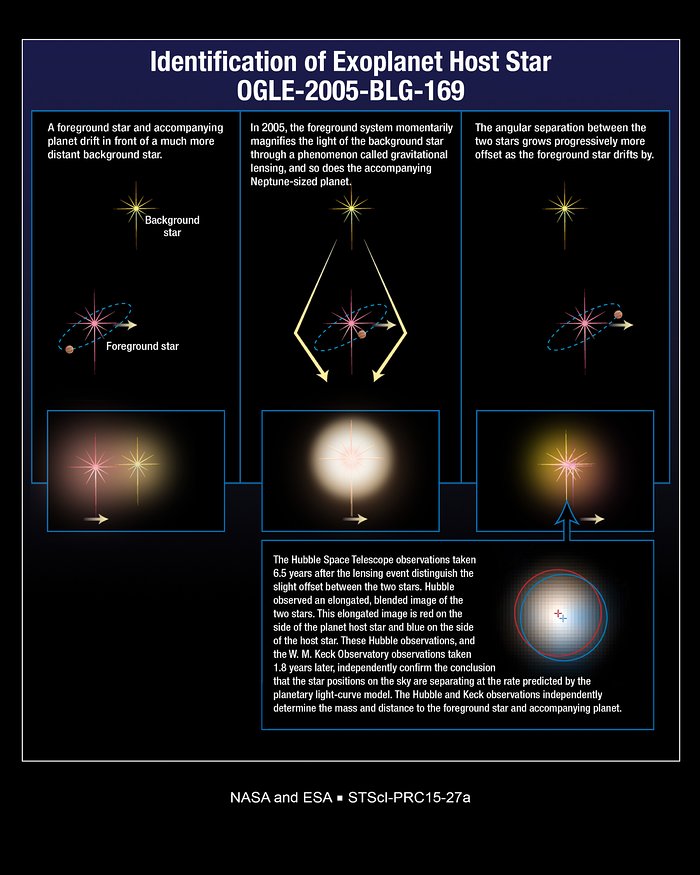 Identifying PlanetsAugust 3, 2015