
Black holes
Trajectory of Smith Cloud
January 28, 2016 · NASA · Smith Cloud, Milky Way
This diagram shows the 100-million-year-long trajectory of the Smith Cloud as it arcs out of the plane of our Milky Way galaxy and then returns like a boomerang. Hubble Space Telescope measurements show that the cloud, because of its chemical composition, came out of a region near the edge of the galaxy's disk of stars 70 million years ago. The cloud is now stretched into the shape of a comet by gravity and gas pressure. Following a ballistic path, the cloud will fall back into the disk and trigger new star formation 30 million years from now.
About the data
The HST data were taken from proposal 13840 : A. Fox and K. Sembach (STScI), F. Lockman (NRAO/Green Bank), B. Menard (Johns Hopkins University), N. Lehner (University of Notre Dame), A. Hill (Haverford College), K. Barger (Texas Christian University), F. Heitsch and D.V. Stark (University of North Carolina, Chapel Hill), M. Rahman (Johns Hopkins University), and R. Benjamin (University of Wisconsin, Whitewater).
The science team for these findings includes: A. Fox (STScI), N. Lehner (University of Notre Dame), F. Lockman (NRAO/Green Bank), B. Wakker (University of Wisconsin, Madison), A. Hill (Haverford College), F. Heitsch (University of North Carolina, Chapel Hill), D.V. Stark (University of North Carolina, Chapel Hill/Kavli Institute, Kashiwa, Japan), K. Barger (Texas Christian University), K. Sembach (STScI), and M. Rahman (Johns Hopkins University).
More Hubble images of Smith Cloud, Milky Way
 Size of Smith Cloud on the SkyJanuary 28, 2016
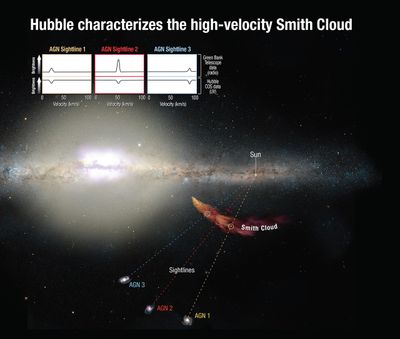 Hubble Characterizes the High-Velocity Smith CloudJanuary 28, 2016
 Black Hole in NGC 1600April 6, 2016
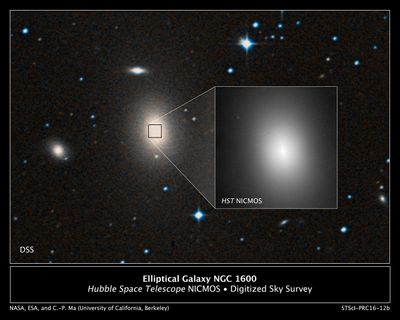 A View of the Giant Elliptical Galaxy NGC 1600April 6, 2016
NGC 1600 – HST NICMOSApril 6, 2016
NGC 1600 – DSSApril 6, 2016
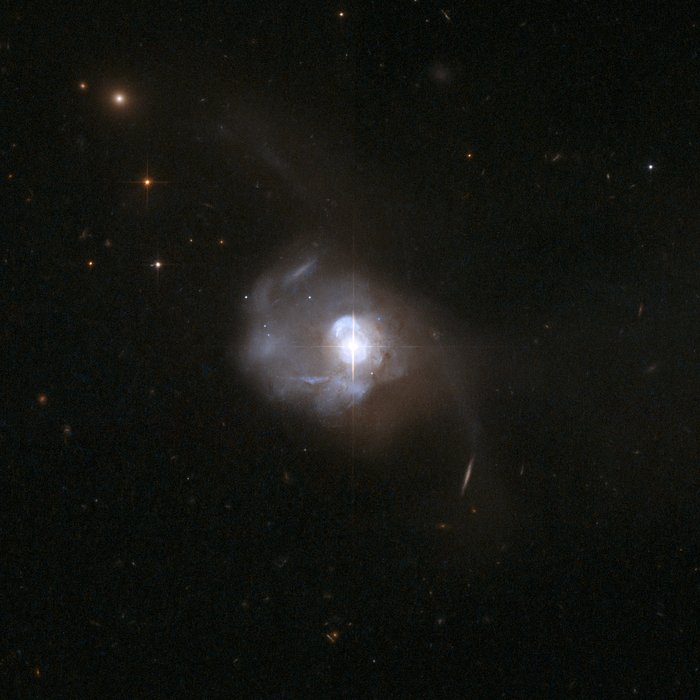 Markarian 231, host galaxy of double black holeAugust 28, 2015
Quasar Host Galaxy Markarian 231August 27, 2015