
Solar System
Neptune Cloud Cover Over Three Decades
August 17, 2023 · NASA
This sequence of Hubble Space Telescope images chronicles the waxing and waning of the amount of cloud cover on Neptune. This long set of observations shows that the number of clouds grows increasingly following a peak in the solar cycle – where the Sun's level of activity rhythmically rises and falls over an 11-year period.
The chemical changes are caused by photochemistry, which happens high in Neptune's upper atmosphere and takes time to form clouds.
In 1989, NASA's Voyager 2 spacecraft provided the first close-up images of linear, bright clouds, reminiscent of cirrus clouds on Earth, seen high in Neptune's atmosphere. They form above most of the methane in Neptune's atmosphere and reflect all colors of sunlight, which makes them white. Hubble picks up where the brief Voyager flyby left off by continually keeping an eye on the planet yearly.
About the colours
These images were acquired by the WFPC2 and WFC3 instruments on the Hubble Space Telescope. The color results from assigning a blue hue to a monochromatic (grayscale) image.
About the data
The HST observations include those from several programs throughout three decades of observations including: 5221 , 5329 , 5831 , 6219 , 6650 , 7324 , 8634 , 9393 , 10170 , 10534 , 11156 , 11630 , 12675 , 13937 , 14044 , 14334 , 14756 , 15262 , 15502 , 16057 , 16084 , 16454
More Hubble images of Neptune
Neptune Cloud Cover and Solar Cycle Over Three DecadesAugust 17, 2023
NeptuneNovember 18, 2021
Neptune Dark SpotDecember 15, 2020
 A storm is comingFebruary 18, 2019
 Neptune’s shrinking vortexFebruary 19, 2018
Neptune’s Mysterious Shrinking StormFebruary 15, 2018
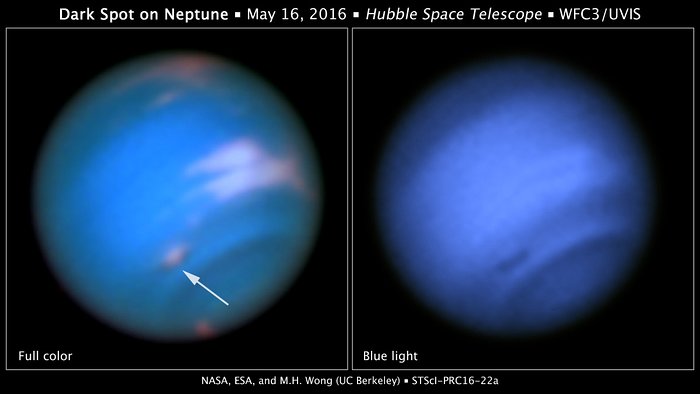 Dark spot on NeptuneJune 27, 2016
 Neptune (full colour)June 27, 2016