
Solar System
Neptune
November 18, 2021 · NASA
In observations taken on September 7th, researchers found that Neptune’s dark spot, which recently was found to have reversed course from moving toward the equator, is still visible in this image, along with a darkened northern hemisphere. There is also a notable dark, elongated circle encompassing Neptune’s south pole. Neptune's and Uranus’ blue color is a result of the absorption of red light by the planets’ methane-rich atmosphere, combined with the same Rayleigh-scattering process that makes the Earth's sky blue. In 2021, there are few bright clouds on Neptune, and its distinct blue with a singular large dark spot is very reminiscent of what Voyager 2 saw in 1989.
About the colours
These images are a composite of separate exposures acquired by the WFC3 instrument on the Hubble Space Telescope. Several filters were used to sample medium wavelength ranges. The color results from assigning different hues (colors) to each monochromatic (grayscale) image associated with an individual filter. In this case, the assigned colors are: Blue: F467M, Green: F547M, Red: F657N
About the data
The HST observations include those from program 16266 (A. Simon)
More Hubble images of Neptune
Neptune Cloud Cover Over Three DecadesAugust 17, 2023
Neptune Cloud Cover and Solar Cycle Over Three DecadesAugust 17, 2023
Neptune Dark SpotDecember 15, 2020
 A storm is comingFebruary 18, 2019
 Neptune’s shrinking vortexFebruary 19, 2018
Neptune’s Mysterious Shrinking StormFebruary 15, 2018
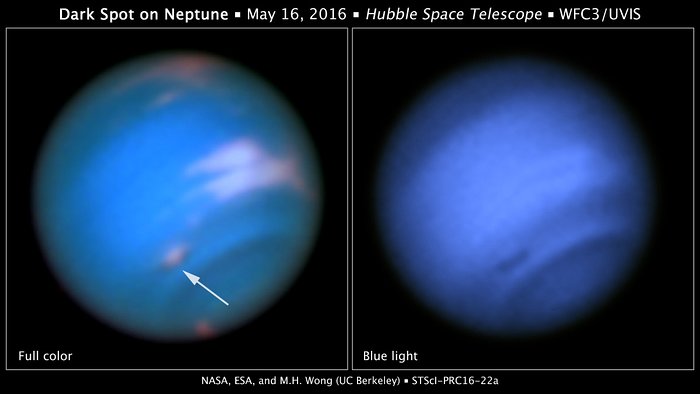 Dark spot on NeptuneJune 27, 2016
 Neptune (full colour)June 27, 2016