
Solar System
Hubble’s Decade-Long Views of the Outer Solar System Planets
December 9, 2024 · NASA · OPAL Observations
This is a montage of Hubble Space Telescope views of our solar system's four giant outer planets: Jupiter, Saturn, Uranus, and Neptune, each shown in enhanced color. The images were taken over nearly 10 years, from 2014 to 2024. This long baseline allows astronomers to track seasonal changes in each planet's turbulent atmosphere, with the sharpness of the NASA planetary flyby probes of the 1980s. These images were taken under a program called OPAL (Outer Planet Atmospheres Legacy).
From upper-left toward center, the hazy white polar cap on the three teal-colored Uranus images appears more face-on as the planet approaches northern summer.
From center-right to far-center right, three images of the blue planet Neptune show the coming and going of clouds as the Sun's radiation level changes. Several of Neptune's mysterious dark spots have come and gone sequentially over OPAL's decade of observations.
Seven views of yellow-brown Saturn stretch across the center of the mosaic in a triangle—one for each year of OPAL observations—showing the tilt of the ring plane relative to the view from Earth. Approximately every 15 years the relatively paper-thin rings (about one mile thick) can be seen edge-on. In 2018 they were near their maximum tilt toward Earth. Colorful changes in Saturn's bands of clouds can be followed as the weather changes.
At bottom center, three images of Jupiter spanning nearly a decade, form a triangle. There are notable changes in Jupiter's banded cloud structure of zones and belts. OPAL measured shrinking of the legendary Great Red Spot, while its rotation period shortens.
About the colours
These images are a composite of separate exposures acquired by the WFC3 instrument on the Hubble Space Telescope. Several filters were used to sample medium wavelength ranges. The color results from assigning different hues (colors) to each monochromatic (grayscale) image associated with an individual filter.
About the data
The HST observations include those from the OPAL observing programs (A. Simon)
More solar system
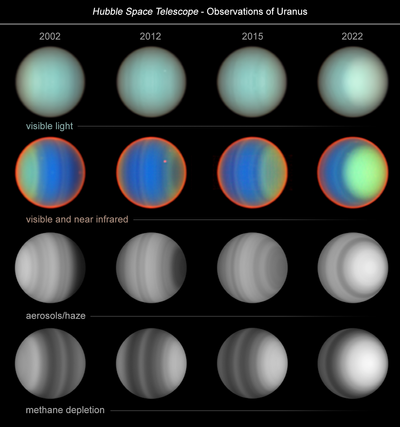 20 Years of Uranus ObservationsMarch 31, 2025
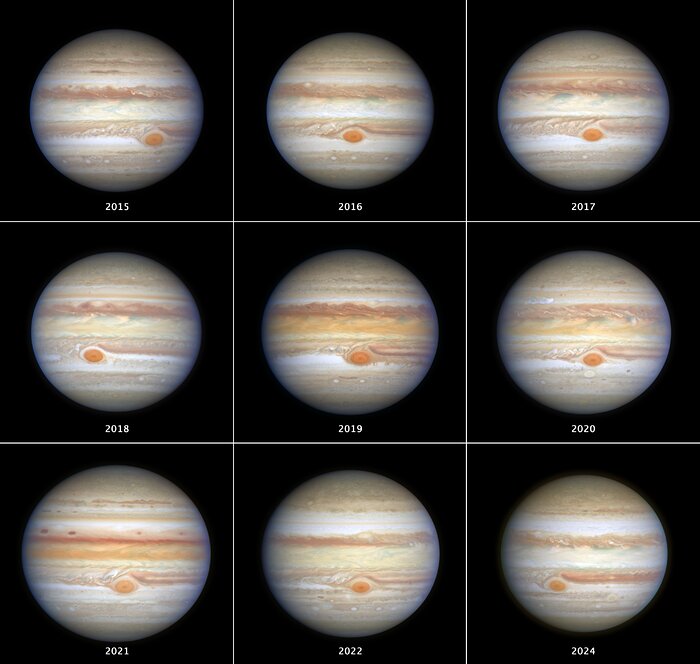 Hubble Jupiter OPAL observations (2015-2024)December 9, 2024
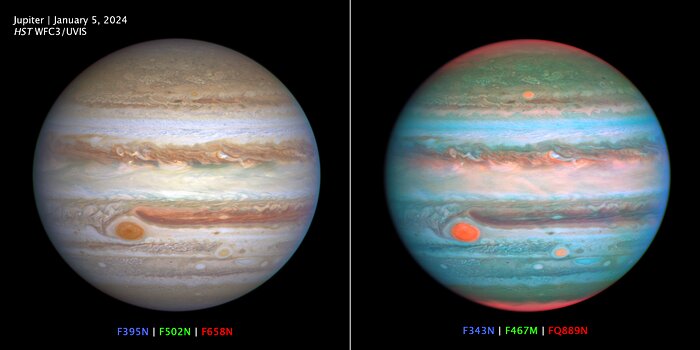 Multiwavelength OPAL Jupiter observation 2024December 9, 2024
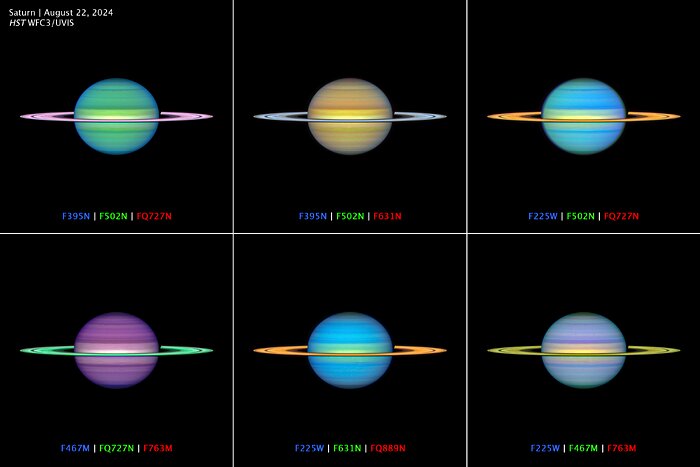 Multiwavelength OPAL Saturn observation 2024December 9, 2024
OPAL Jupiter ObservationsDecember 9, 2024
Multiwavelength OPAL JupiterDecember 9, 2024
Multiwavelength OPAL SaturnDecember 9, 2024
Evolution of Saturn’s Ring Tilt (2018-2024)December 9, 2024 · video