
Solar System
Hubble and New Horizons Views of Uranus
October 9, 2024 · NASA
In this image, two three-dimensional shapes (top) of Uranus are compared to the actual views of the planet from NASA's Hubble Space Telescope (bottom left) and NASA's New Horizon's spacecraft (bottom right). These two missions recently simultaneously observed the gas giant , comparing high-resolution images from Hubble to the smaller view from New Horizons. This combined perspective will help researchers learn more about what to expect while imaging planets around other stars with future observatories.
The gas giant planets in our solar system have dynamic and variable atmospheres with changing cloud cover. By knowing the details of what the clouds on Uranus looked like from Hubble, researchers are able to verify what is interpreted from the New Horizons data.
While it was clear the cloud features were not changing with the planet's rotation, Uranus appeared dimmer in the New Horizons data than expected.
Researchers found this has to do with how the planet reflects light at a different phase than what Hubble can see. This showed that exoplanets may be dimmer than predicted at partial and high phase angles, and that the atmosphere reflects light differently at partial phase.
About the colours
These images are a composite of separate exposures acquired by the WFC3 instrument on the Hubble Space Telescope. Several filters were used to sample medium wavelength ranges. The color results from assigning different hues (colors) to each monochromatic (grayscale) image associated with an individual filter. In this case, the assigned colors are: Blue: F467M, Green:F657N, Red: F845M
About the data
The HST observations include those from program 17294 (A. Simon)
More Hubble images of Uranus
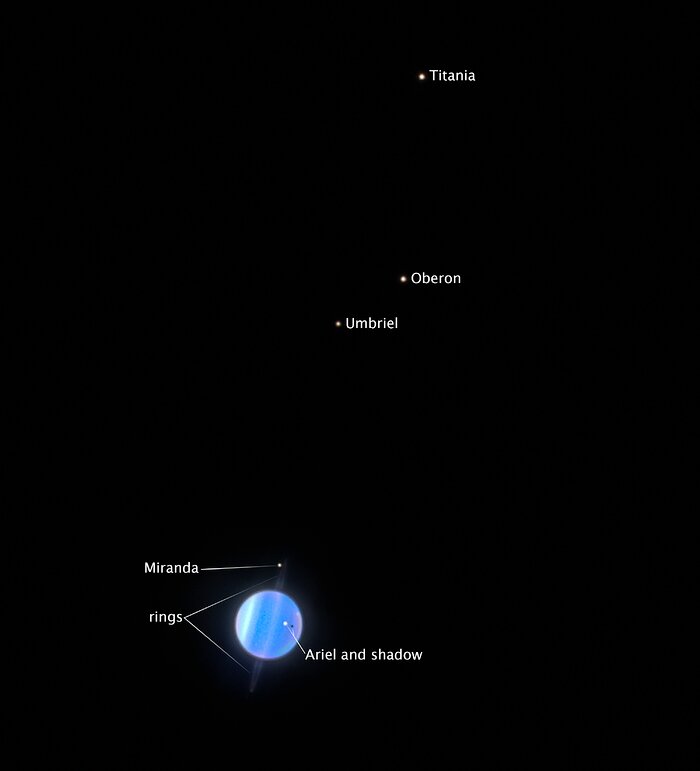 Uranus and its four largest moonsJune 10, 2025
 Uranus Aurorae Image Trio (October 2022)April 9, 2025
 Close-up: Uranus Aurorae (October 2022)April 9, 2025
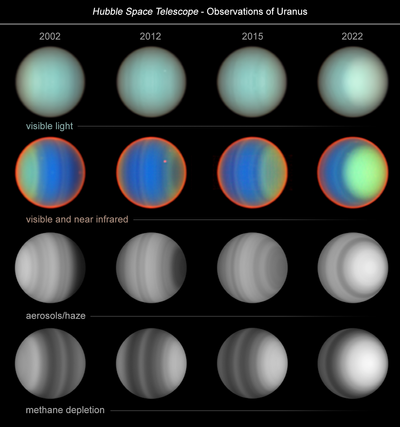 20 Years of Uranus ObservationsMarch 31, 2025
Uranus (Nov. 2014 and Nov. 2022)March 23, 2023
UranusNovember 18, 2021
 Adding to Uranus’s legacyFebruary 11, 2019
 Alien aurorae on UranusApril 3, 2017