
Solar System
Uranus
November 18, 2021 · NASA
Hubble’s October 25th view of Uranus puts the planet’s bright northern polar hood in the spotlight. It’s springtime in the northern hemisphere and the increase in ultraviolet radiation absorbed from the Sun seems to be causing the polar region to brighten. Researchers are studying how the brightening polar hood results from changes in the concentration of atmospheric methane gas and the characteristics of haze particles, as well as the atmospheric flow patterns. Curiously, even as the atmospheric hood gets brighter, the sharp southernmost boundary remains fixed at the same latitude. This has been constant over the past several years of OPAL observations, perhaps because a jet stream is setting up a barrier at that latitude of 43 degrees.
About the colours
These images are a composite of separate exposures acquired by the WFC3 instrument on the Hubble Space Telescope. Several filters were used to sample medium wavelength ranges. The color results from assigning different hues (colors) to each monochromatic (grayscale) image associated with an individual filter. In this case, the assigned colors are: Blue: F467M, Green: F547M, Orange: F657N, Red: F845M
About the data
The HST observations include those from program 16266 (A. Simon)
More Hubble images of Uranus
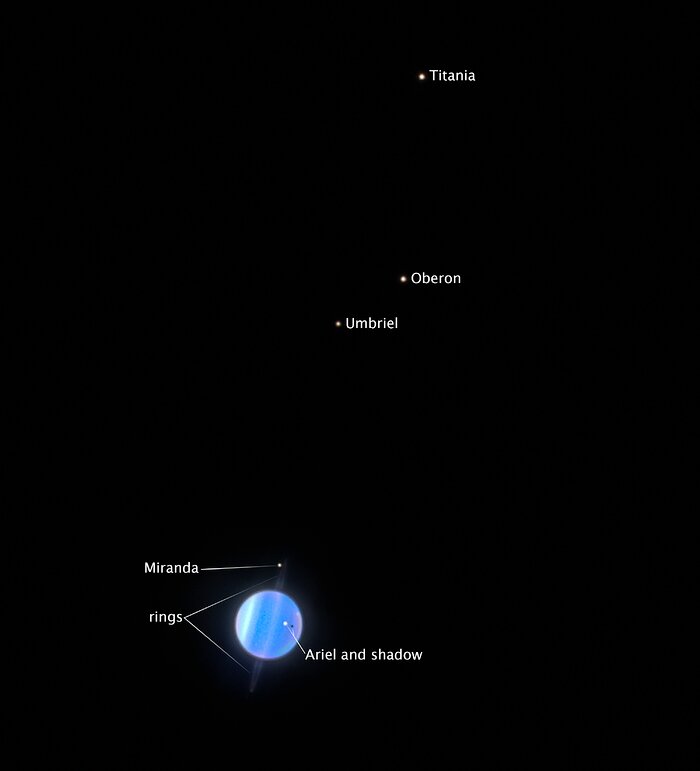 Uranus and its four largest moonsJune 10, 2025
 Uranus Aurorae Image Trio (October 2022)April 9, 2025
 Close-up: Uranus Aurorae (October 2022)April 9, 2025
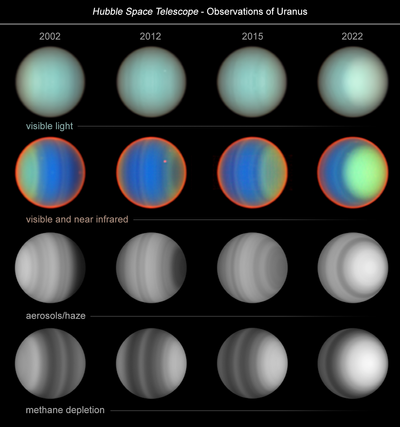 20 Years of Uranus ObservationsMarch 31, 2025
Hubble and New Horizons Views of UranusOctober 9, 2024
Uranus (Nov. 2014 and Nov. 2022)March 23, 2023
 Adding to Uranus’s legacyFebruary 11, 2019
 Alien aurorae on UranusApril 3, 2017