
Galaxies
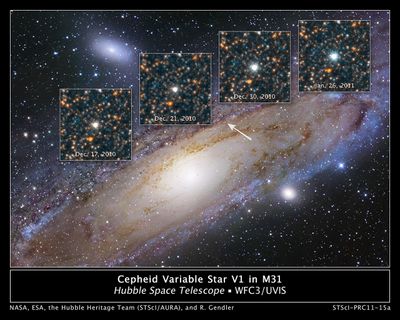
Cepheid Variable Star V1 in Andromeda Galaxy
January 15, 2025 · NASA · M31-V1, M31 · Andromeda
Zoom to full resolution See where it is in the 3D sky Original on NASA ↗
In commemoration of Edwin Hubble's discovery of a Cepheid variable class star, called V1, in the neighboring Andromeda galaxy 100 years ago, astronomers partnered with the American Association of Variable Star Observers (AAVSO) to study the star. AAVSO observers followed V1 for six months, producing a plot, or light curve, of the rhythmic rise and fall of the star's light. Based on this data, the Hubble Space Telescope was scheduled to capture the star at its dimmest and brightest light. Edwin Hubble’s observations of V1 became the critical first step in uncovering a larger, grander universe than some astronomers imagined at the time. Once dismissed as a nearby "spiral nebula" measurements of Andromeda with its embedded Cepheid star served as a stellar milepost marker. It definitively showed that Andromeda was far outside of our Milky Way. Edwin Hubble went on to measure the distances to many galaxies beyond the Milky Way by finding Cepheid variables within those levels. The velocities of those galaxies, in turn, allowed him to determine that the universe is expanding.
About the colours
These images (inset) are a composite of separate exposures acquired by the WFC3 instrument on HST. Several filters were used to sample broad wavelength ranges. The color results from assigning different hues (colors) to each monochromatic (grayscale) image associated with an individual filter. In this case, the assigned colors are: Cyan: F475X (Wide Blue) Orange: F600LP (Long Pass)
About the data
The image (inset) was created from Hubble data from proposal 12326 : K. Noll (PI), Z. Levay, M. Mutchler, T. Borders, L. Frattare, M. Livio, C. Christian, D. Soderblom, and H. Bond (Hubble Heritage Team/STScI). Note: The Hubble Space Telescope observations of Hubble's Variable M31-V1 were made possible from ground-based data provided by the American Association of Variable Star Observers (AAVSO).
More Hubble images of M31-V1, M31
 M31 Cepheid Variable Star V1January 15, 2025
 Hubble Views the Star that Changed the UniverseMay 23, 2011
 Andromeda GalaxyJuly 27, 2026
Survey of Andromeda’s Satellite GalaxiesFebruary 27, 2025
 Hubble’s panoramic view of the Andromeda GalaxyJanuary 16, 2025
Hubble M31 PHAT+PHAST MosaicJanuary 16, 2025
 A Cosmic DrawFebruary 7, 2022
 Cosmic Cinnamon BunNovember 16, 2020