
Galaxies · ESA/Hubble Picture of the Week
Approaching the Universe’s origins
April 16, 2018 · ESA/Hubble · PSZ2 G138.61-10.84 · Andromeda
Zoom to full resolution See where it is in the 3D sky Original on ESA/Hubble ↗
This intriguing image from the NASA/ESA Hubble Space Telescope shows a massive galaxy cluster called PSZ2 G138.61-10.84, about six billion light-years away. Galaxies are not randomly distributed in space, but rather aggregated in groups, clusters and superclusters . The latter span over hundreds of millions of light-years and contain billions of galaxies.
Our own galaxy, for example, is part of the Local Group , which in turn is part of the giant Laniakea Supercluster . It was thanks to Hubble that we were able to study massive galactic superstructures such as the Hercules-Corona Borealis Great Wall ; a giant galaxy cluster that contains billions of galaxies and extends 10 billion light-years across — making it the biggest known structure in the Universe.
This image was taken by Hubble’s Advanced Camera for Surveys and Wide-Field Camera 3 as part of an observing programme called RELICS (Reionization Lensing Cluster Survey) . RELICS imaged 41 massive galaxy clusters with the aim of finding the brightest distant galaxies for the forthcoming NASA/ESA/CSA James Webb Space Telescope (JWST) to study.
More from Andromeda and nearby
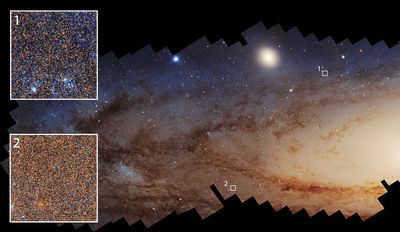 Andromeda GalaxyJuly 27, 2026
Survey of Andromeda’s Satellite GalaxiesFebruary 27, 2025
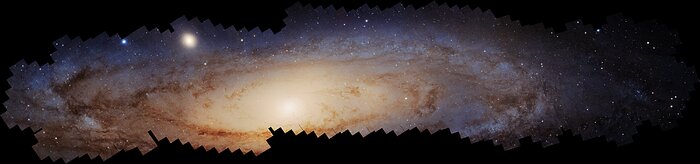 Hubble’s panoramic view of the Andromeda GalaxyJanuary 16, 2025
Hubble M31 PHAT+PHAST MosaicJanuary 16, 2025
 M31 Cepheid Variable Star V1January 15, 2025
 Cepheid Variable Star V1 in Andromeda GalaxyJanuary 15, 2025
 A Cosmic DrawFebruary 7, 2022
 Cosmic Cinnamon BunNovember 16, 2020