
Illustrations
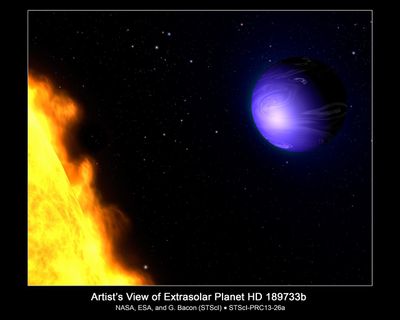
Artist’s Concept of Extrasolar Planet’s Hazy Atmosphere
December 11, 2007 · NASA · HD 189733, HD189733b · Vulpecula
Zoom to full resolution See where it is in the 3D sky Original on NASA ↗
A team of astronomers, led by Frederic Pont from the Geneva University Observatory in Switzerland, has detected for the first time strong evidence of hazes in the atmosphere of a planet orbiting a distant star. The new Hubble Space Telescope observations were made as the extrasolar planet, dubbed HD 189733b, passed in front of its parent star in an eclipse. As the light from the star briefly passes through the exoplanet's atmosphere, the gases in the atmosphere stamp their unique spectral fingerprints on the starlight. Where the scientists had expected to see the fingerprints of sodium and potassium, there were none; implying that high-level hazes (with an altitude of nearly 2,000 miles) are responsible for blocking the light from these elements. This is an artist's concept of HD 189733b and its parent star.
About the data
This image was created from HST data from proposal 10869 :
A. Lecavelier des Etangs, A. Vidal-Madjar, F. Bouchy , J.-M. Desert, D. Ehrenreich, R. Ferlet, G. Hebrard, and G. Tinetti (CNRS, Paris Institute of Astrophysics), G. Ballester (University of Arizona), and F. Pont and S. Udry (Geneva University Observatory, Switzerland).
The science team comprises: F. Pont (Geneva University Observatory, Switzerland) , H. Knutson (Harvard-Smithsonian Center for Astrophysics), R. Gilliland (STScI), C. Moutou (Astrophysics Laboratory of Marseille, France), and D. Charbonneau (Harvard-Smithsonian Center for Astrophysics).
More from Vulpecula and nearby
 The icy blue wings of Hen 2-437February 8, 2016
 Artist’s View of Extrasolar Planet HD 189733bJuly 11, 2013
 Gravitational Lens Creates Cartoon of Space InvaderMarch 5, 2013
Galaxy Cluster Abell 68March 5, 2013
Gravitationally Lensed Image of Distant Galaxy in Abell 68March 5, 2013
Heritage Image of Galaxy Cluster Abell 68March 5, 2013
Artist’s View of Exoplanet Orbiting the Star HD 189733December 9, 2008
 IRAS 20351+2521April 24, 2008