
Galaxies
Snapshots of the Star that Changed the Universe
May 23, 2011 · NASA · Andromeda Galaxy, M31 · Andromeda
Zoom to full resolution See where it is in the 3D sky Original on NASA ↗
Views of a famous pulsating star taken nearly 90 years apart and a portrait of its galactic home are shown in this image collection.
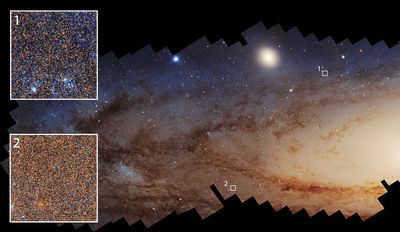
The pancake-shaped disk of stars, gas, and dust that make up the Andromeda galaxy, or M31, is shown in the image at left. Andromeda is a Milky Way neighbor and resides 2 million light-years away.
The tiny white box just above center outlines the Hubble Space Telescope view. An arrow points to the Hubble image, taken by the Wide Field Camera 3. The snapshot is blanketed with stars, which look like grains of sand.
The white circle at lower left identifies Hubble variable number one, or V1, the Cepheid variable star discovered by astronomer Edwin Hubble in 1923. Cepheid variables are pulsating stars that brighten and fade in a predictable pattern. Astronomers use them to calculate how far away they are from Earth.
The large white box outlines the region imaged by astronomer Edwin Hubble, who used the 100-inch Hooker telescope, the most powerful telescope of that era. An arrow points to a copy of Hubble's image of Andromeda, which was made on a 4-inch-by-5-inch glass plate and dated Oct. 6, 1923.
Edwin Hubble originally identified three novae, a class of exploding star, by writing "N" next to each object. Later, Hubble realized that the nova at top right was actually a Cepheid variable. He crossed out the "N" and wrote "VAR," for variable. This star allowed Hubble to calculate a reliable distance to Andromeda, proving that it was a separate galaxy outside our Milky Way.
About the colours
This image (top inset) is a composite of separate exposures acquired by the WFC3 instrument on HST. Several filters were used to sample broad wavelength ranges. The color results from assigning different hues (colors) to each monochromatic (grayscale) image associated with an individual filter. In this case, the assigned colors are: Cyan: F475X (Wide Blue) Orange: F600LP (Long Pass)
About the data
The image (top inset) was created from Hubble data from proposal 12326 : K. Noll (PI), Z. Levay, M. Mutchler, T. Borders, L. Frattare, M. Livio, C. Christian, D. Soderblom, and H. Bond (Hubble Heritage Team/STScI).
Note: The Hubble Space Telescope observations of Hubble's Variable M31-V1 were made possible from ground-based data provided by the American Association of Variable Star Observers (AAVSO).
More from Andromeda and nearby
 Andromeda GalaxyJuly 27, 2026
Survey of Andromeda’s Satellite GalaxiesFebruary 27, 2025
 Hubble’s panoramic view of the Andromeda GalaxyJanuary 16, 2025
Hubble M31 PHAT+PHAST MosaicJanuary 16, 2025
 M31 Cepheid Variable Star V1January 15, 2025
 Cepheid Variable Star V1 in Andromeda GalaxyJanuary 15, 2025
 A Cosmic DrawFebruary 7, 2022
 Cosmic Cinnamon BunNovember 16, 2020