
Star clusters
Star Clusters in the Andromeda Galaxy
September 3, 2015 · NASA · M31, Andromeda Galaxy · Andromeda
Zoom to full resolution See where it is in the 3D sky Original on NASA ↗
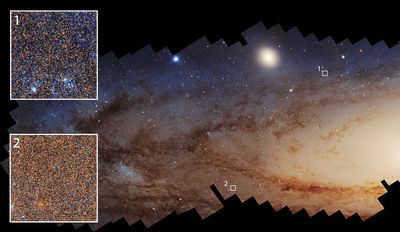
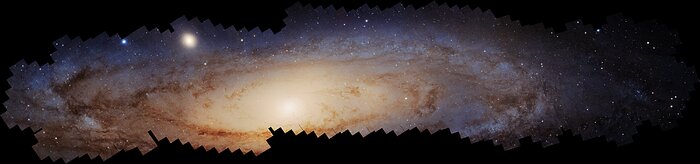
[Top] – This is a Hubble Space Telescope mosaic of 414 photographs of the nearest major galaxy to our Milky Way galaxy, the Andromeda galaxy (M31). The vast panorama was assembled from nearly 8,000 separate exposures taken in near-ultraviolet, visible, and near-infrared light. Embedded within this view are 2,753 star clusters. The view is 61,600 light-years across and contains images of 117 million stars in the galaxy's disk.
[Bottom-Left] – An enlargement of the boxed field in the top image reveals myriad stars and numerous open star clusters as bright blue knots. Hubble's bird's-eye view of M31 allowed astronomers to conduct a larger-than-ever sampling of star clusters that are all at the same distance from Earth, 2.5 million light-years. The view is 4,400 light-years across.
[Bottom-Right] – This is a view of six bright blue clusters extracted from the field. Hubble astronomers discovered that, for whatever reason, nature apparently cooks up stars with a consistent distribution from massive stars to small stars (blue supergiants to red dwarfs). This remains a constant across the galaxy, despite the fact that the clusters vary in mass by a factor of 10 and range in age from 4 million to 24 million years old. Each cluster square is 150 light-years across.
About the colours
These images are composites of separate exposures acquired by the ACS and WFC3 instruments on the Hubble Space Telescope. Several filters were used to sample broad wavelength ranges. The color results from assigning different hues (colors) to each monochromatic (grayscale) image associated with an individual filter. In this case, the assigned colors are: Blue: WFC3/UVIS F336W (U) Green: ACS/WFC F475W (g) Yellow: ACS/WFC F814W (I) Red: WFC3/IR F160W (H)
About the data
Data of M31 were obtained from the HST PHAT Treasury Proposals: P.I. J. Dalcanton (University of Washington) et al. 12055 , 12056 , 12057 , 12058 , 12059 , 12076 , 12070 , 12071 , 12072 , 12073 , 12074 , 12075 , 12114 , 12105 , 12106 , 12107 , 12108 , 12109 , 12111 , 12112 , 12113 , 12114 , and 12115 .
The science team comprises: D. Weisz and L.C. Johnson (University of Washington), D. Foreman-Mackey (New York University), A. Dolphin (Raytheon Company), L. Beerman, B. Williams, and J. Dalcanton (University of Washington), H.-W. Rix (Max Planck Institute for Astronomy, Heidelberg), D. Hogg (New York University/Max Planck Institute for Astronomy, Heidelberg), M. Fouesneau (Max Planck Institute for Astronomy, Heidelberg), B. Johnson (Harvard-Smithsonian Center for Astrophysics), E. Bell (University of Michigan), M. Boyer (STScI), D. Gouliermis (Max Planck Institute for Astronomy/University of Heidelberg), P. Guhathakurta (University of California, Santa Cruz), J. Kalirai (STScI), A. Lewis (University of Washington), A. Seth (University of Utah), and E. Skillman (University of Minnesota).
More Hubble images of M31, Andromeda Galaxy
Andromeda Galaxy (M31) MosaicSeptember 3, 2015
Closeup of Region of Andromeda Galaxy and Star ClustersSeptember 3, 2015
 Andromeda GalaxyJuly 27, 2026
Survey of Andromeda’s Satellite GalaxiesFebruary 27, 2025
 Hubble’s panoramic view of the Andromeda GalaxyJanuary 16, 2025
Hubble M31 PHAT+PHAST MosaicJanuary 16, 2025
 M31 Cepheid Variable Star V1January 15, 2025
 Cepheid Variable Star V1 in Andromeda GalaxyJanuary 15, 2025