
Solar System
Dark Spot on Neptune
June 23, 2016 · NASA
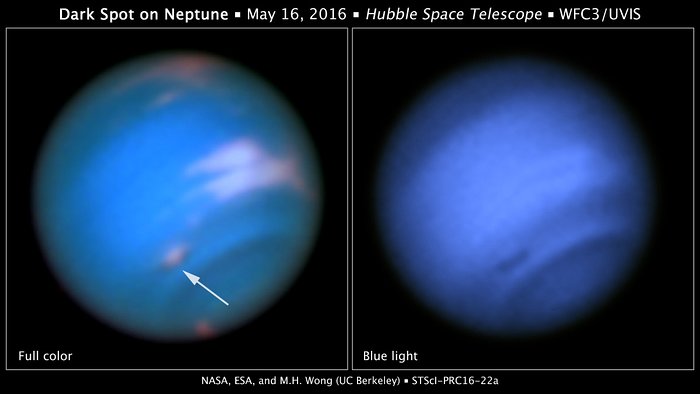
This new Hubble Space Telescope image confirms the presence of a dark vortex in the atmosphere of Neptune.
The full visible-light image at left shows that the dark feature resides near and below a patch of bright clouds in the planet's southern hemisphere. The dark spot measures roughly 3,000 miles (4,800 kilometers) across. Other high-altitude clouds can be seen at the planet's equatorial region and polar regions.
The image at right shows that Neptune's dark vortices are typically best seen at blue wavelengths. Only Hubble has the high resolution required for identifying such weather features on distant Neptune.
Though similar features were seen during the Voyager 2 flyby of Neptune in 1989 and by Hubble in 1994, this vortex is the first one observed on the planet in the 21st century.
In September 2015, the Outer Planet Atmospheres Legacy (OPAL) program, a long-term Hubble Space Telescope project that annually captures global maps of the outer planets, revealed a dark spot close to the location of the bright clouds, which had been tracked from the ground. By viewing the vortex a second time, the new Hubble images, taken by Wide Field Camera 3 on May 16, 2016, confirm that OPAL really detected a long-lived feature. With the new data, the team created a higher-quality map of the vortex and its surroundings.
The team, led by Mike Wong (UC Berkeley), also included the OPAL team (Wong, Amy Simon (GSFC), and Glenn Orton (JPL)), UC Berkeley collaborators (Imke de Pater, Joshua Tollefson, and Katherine de Kleer), Heidi Hammel (AURA), Statia Luszcz-Cook (AMNH), Ricardo Hueso and Agustin Sánchez-Lavega (Universidad del Pais Vasco), Marc Delcroix (Société Astronomique de France), Larry Sromovsky and Patrick Fry (University of Wisconsin), and Christoph Baranec (University of Hawaii).
About the colours
This image is a composite of separate exposures acquired by the WFC3/UVIS instrument. In the full globe and top detail image, several filters were used to sample various wavelengths. The color results from assigning different hues (colors) to each monochromatic (grayscale) image associated with an individual filter. In this case, the assigned colors are: Blue: F467M Green: F547M Red: F763M
About the data
Data were provided by the HST proposal 14492 : M.H. Wong (PI), I. de Pater, J. Tollefson, and K. de Kleer (UC Berkeley), H. Hammel (Space Science Institute), S. Cook (AMNH), R. Hueso and A. Sanchez-Lavega (University of the Basque Country, Spain), A. Simon (NASA/GSFC), M. Delcroix (French Astronomical Society, SAF), L. Sromovsky and P. Fry (University of Wisconsin, Madison), G. Orton (JPL), and C. Baranec (University of Hawaii, Manoa).
More Hubble images of Neptune
Neptune Cloud Cover Over Three DecadesAugust 17, 2023
Neptune Cloud Cover and Solar Cycle Over Three DecadesAugust 17, 2023
NeptuneNovember 18, 2021
Neptune Dark SpotDecember 15, 2020
 A storm is comingFebruary 18, 2019
 Neptune’s shrinking vortexFebruary 19, 2018
Neptune’s Mysterious Shrinking StormFebruary 15, 2018
 Dark spot on NeptuneJune 27, 2016